
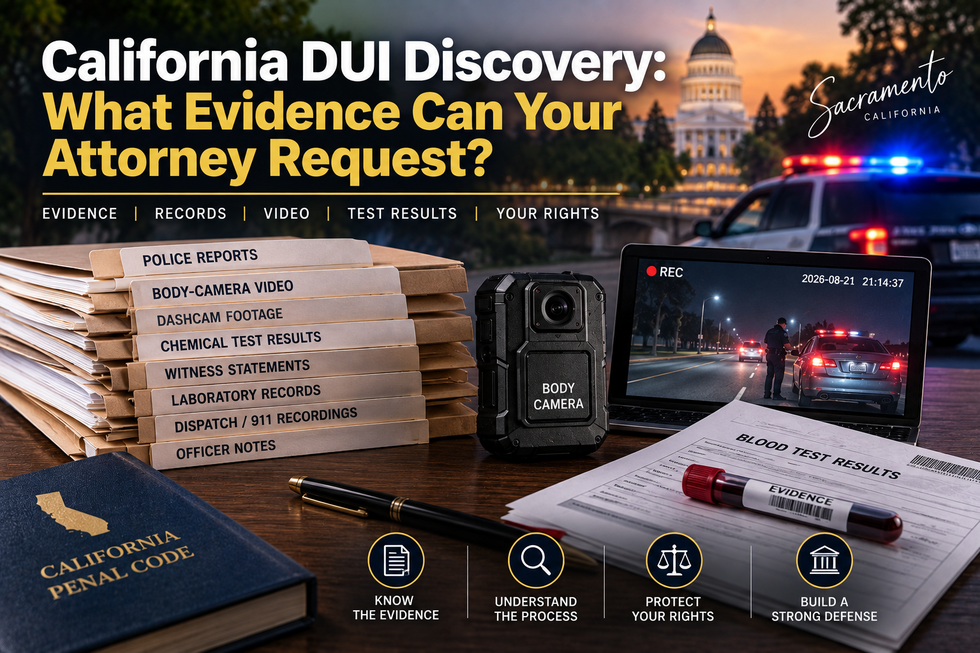
When I represent someone facing a DUI charge in California, one of the first things I want to understand is not simply what the police say happened, but what evidence actually exists to support that account.
A DUI case can involve far more than a police report. Depending on the circumstances, there may be body-camera recordings, dashcam or in-car video, 911 calls, dispatch records, witness statements, field sobriety test observations, preliminary alcohol screening results, breath-test records, blood-test documentation, laboratory records, photographs, officer notes, calibration or maintenance records, and other evidence.
California criminal discovery laws provide a framework for obtaining information from the prosecution and investigating agencies. Penal Code section 1054.1 identifies categories of information and materials that the prosecution must disclose when they are in the prosecutor's possession or the prosecutor knows they are in the possession of investigating agencies. Those categories include relevant real evidence, defendant statements, exculpatory evidence, prosecution witness information, and relevant witness and expert statements and reports.
In my practice, I view discovery as much more than a stack of documents. It is a way to test the government's evidence, identify inconsistencies, determine what information may be missing, and understand how the prosecution intends to prove the case.
What Is Discovery in a California DUI Case?
In simple terms, discovery is the process through which the parties obtain information and evidence relevant to a criminal case.
California's criminal discovery statutes are found primarily in Penal Code sections 1054 through 1054.7. Section 1054.1 establishes several categories of information the prosecution must disclose to the defense when the statutory requirements are satisfied.
Discovery can therefore give the defense a much broader view of a DUI investigation than the citation or initial police report alone.
For example, a police report might say that an officer observed certain driving behavior. A video recording could show the actual driving conduct. An officer might describe a person's performance on field sobriety tests in one way, while a recording could allow the defense to independently evaluate what actually occurred.
That difference is one reason I want to see the underlying evidence whenever it is relevant and available.
What Evidence Can a DUI Attorney Request?
The exact discovery request depends on the facts of the case. In a typical California DUI matter, I may look for several categories of evidence.
Police Reports
Reports describing the stop, investigation, observations, statements, arrest and testing process.
Video Evidence
Body-camera, dashcam, in-car video and other recordings when they exist and are discoverable.
Chemical Testing
Breath, blood or other testing information, depending on the circumstances of the arrest.
Witness Evidence
Relevant statements, reports and information concerning witnesses the prosecution intends to call.
Expert Materials
Relevant reports, statements and scientific testing information that may be offered as evidence.
Exculpatory Evidence
Evidence favorable to the defense that may be relevant to guilt, punishment or credibility.
1. The DUI Police Report
The police report is usually one of the first documents I review, but I do not treat it as the complete DUI case.
A report may describe why an officer stopped a vehicle, what the officer observed, what the driver allegedly said, what field sobriety tests were performed, whether a preliminary alcohol screening device was used, what happened during the arrest, and how chemical testing was conducted.
The report is important because it establishes the prosecution's narrative. It is equally important to remember that it is an officer's account of the investigation, not a judicial finding that every statement in the report is true.
What I Look for in a DUI Report
- Why the officer initially stopped or contacted the driver.
- The timing and sequence of events.
- Descriptions of driving behavior.
- Statements attributed to the driver.
- Observations concerning alcohol or drug impairment.
- Descriptions of field sobriety testing.
- Preliminary alcohol screening information.
- Chemical testing procedures.
- Statements from passengers or other witnesses.
- Any inconsistencies between the report and other available evidence.
2. Body-Camera and Dashcam Video
Video evidence can be particularly important because it may allow the defense to examine events rather than relying exclusively on written descriptions.
Depending on the agency and circumstances, recordings may include body-worn camera footage, patrol-car video, vehicle-mounted systems, or other law-enforcement recordings.
I want to know whether video exists, what period of the encounter it covers, whether there are multiple recordings, and whether the recording contains audio as well as video.
A recording can also raise questions about what happened before the camera was activated, whether there are gaps, whether multiple officers recorded the encounter, and whether the recording accurately represents the event being offered as evidence.
Written reports summarize events. A recording may provide additional context. The two should be compared rather than assuming that one automatically replaces the other.
3. 911 Calls, Dispatch Audio and Communications
Depending on the circumstances, a DUI investigation may generate communications involving dispatch personnel, 911 callers, officers, or other agencies.
I may want to determine whether relevant audio recordings exist and whether they contain information concerning the original reason for the police response, descriptions of driving, collision information, witness observations, or the timing of the investigation.
These records can be particularly useful when the written report does not fully explain how officers first became involved.
4. Breath-Test Evidence
Breath evidence can involve more than the final numerical result.
Depending on the device and circumstances, the defense may need to examine records concerning the testing process, the device, the operator, the timing of the test, applicable procedures, and other information relevant to interpreting the result.
I do not want to look at a number in isolation. I want to understand how that number was generated and what evidence supports the reliability and interpretation of the test.
5. Blood-Test Evidence and Laboratory Records
When a blood sample is involved, the discovery review can become substantially more detailed.
Depending on the case, relevant materials may include laboratory reports, analytical results, information concerning the testing process, documentation relating to the sample, and relevant expert information.
I may also examine whether the evidence establishes an appropriate connection between the specimen collected from the driver and the laboratory result being offered by the prosecution.
The precise discovery available in any case depends on the evidence actually generated and the applicable legal rules.
6. Field Sobriety Test Evidence
Field sobriety testing can become an important part of a DUI investigation. The police report may contain an officer's observations about balance, walking, following instructions, eye movements, or other claimed indicators.
I want to examine the circumstances under which the tests were performed rather than simply accepting a conclusion that a driver "failed" a test.
Conditions can matter. Lighting, weather, footwear, roadway conditions, injuries, physical limitations, instructions, location, timing, and the actual interaction between the officer and driver can all be relevant depending on the facts.
7. Witness Statements and Reports
California Penal Code section 1054.1 includes relevant written or recorded statements of witnesses whom the prosecution intends to call, as well as reports of those statements.
In a DUI case, witnesses can include other officers, civilian witnesses, passengers, people who observed the vehicle, accident witnesses, and expert witnesses, depending on the case.
I compare witness accounts when possible. Differences in timing, location, observations, descriptions of driving, and statements attributed to the driver can become important when evaluating the prosecution's evidence.
8. Expert Reports and Scientific Testing
DUI prosecutions can involve scientific evidence. California's criminal discovery statute specifically addresses relevant reports or statements of experts made in connection with the case, including results of physical or mental examinations, scientific tests, experiments, or comparisons that the prosecution intends to offer into evidence.
When expert evidence is involved, I want to know what the expert was asked to determine, what information the expert reviewed, what testing was performed, and what conclusions were reached.
The purpose is not to automatically challenge every scientific test. The purpose is to understand the evidence sufficiently to determine what conclusions the evidence actually supports.
9. Exculpatory and Favorable Evidence
One of the most important categories is evidence favorable to the defense.
Penal Code section 1054.1 expressly includes exculpatory evidence among the information the prosecution must disclose. Separate constitutional due-process principles also require disclosure of qualifying favorable evidence.
In practical terms, I am not interested only in evidence that makes the prosecution's case stronger. I also look for evidence that may contradict the government's theory, reduce the significance of an observation, undermine a witness's credibility, or otherwise be favorable to the defense.
This is one reason a complete discovery review matters.
10. Officer Credibility and Personnel Records
Officer personnel information is a different category from ordinary criminal discovery and can involve special procedures.
California Evidence Code section 1043 establishes a procedure for seeking discovery of peace-officer personnel records. A criminal case generally requires a written motion identifying the proceeding, the officer, the agency, the type of records sought, and facts supporting good cause and materiality.
This type of request is often associated with what lawyers refer to as a Pitchess motion.
I do not assume that every personnel record is available. The defense must follow the applicable procedure and establish the required legal basis.
Penal Code section 832.7 generally protects peace-officer personnel records from disclosure except through specified procedures, while also creating particular categories of records that may be subject to public disclosure. Criminal discovery and public-records disclosure are not the same process.
Criminal Discovery vs. a Public Records Request
This distinction is extremely important.
| Criminal Discovery | Public Records Request |
|---|---|
|
Connected to a criminal case and governed by criminal discovery rules. |
A request for records under public-records laws. |
|
The prosecution has statutory disclosure obligations. |
The agency evaluates whether requested records are subject to disclosure and whether exemptions apply. |
|
Can include evidence known to or possessed by investigating agencies under applicable rules. |
Does not necessarily provide the same scope or timing as criminal discovery. |
|
Can involve court enforcement when discovery obligations are not satisfied. |
Operates under public-records disclosure procedures and exemptions. |
I do not advise treating a public-records request as a substitute for criminal discovery when a DUI prosecution is pending.
When Should DUI Discovery Be Requested?
Discovery should be addressed early in the case.
California Penal Code section 1054.7 generally requires disclosures at least 30 days before trial, unless good cause supports a different result. The statute also addresses evidence that becomes known to or comes into the possession of a party within 30 days of trial.
In practice, I do not want to wait until the last possible moment to begin reviewing evidence. Early access gives counsel more time to investigate, identify missing materials, evaluate scientific evidence, locate witnesses, and determine whether additional requests or court procedures are appropriate.
What If the Prosecutor Does Not Provide Requested Discovery?
California Penal Code section 1054.5 establishes a procedure for enforcing criminal discovery obligations.
Before seeking court enforcement, the statute generally requires an informal request to opposing counsel. If the requested materials are not provided within the statutory framework, counsel may seek a court order.
Depending on the circumstances, the court has authority to issue orders designed to enforce discovery requirements. Potential remedies can include ordering disclosure, continuing the case, restricting evidence or witness testimony in appropriate circumstances, or other lawful orders.
The appropriate response depends on the specific discovery problem. A missing document is not automatically grounds for dismissal, and the legal consequences of a discovery violation depend on the nature and significance of the evidence and the applicable law.
Can Discovery Include Evidence That Helps the Defense?
Yes. This is one of the central purposes of discovery.
When I review a DUI case, I am looking for the complete evidentiary picture. That includes information favorable to the prosecution and information favorable to the defense.
A recording might support one part of the officer's account while contradicting another. A witness may remember the event differently from what appears in the police report. A laboratory record may raise a question that is not apparent from the final test result. A dispatch record may establish a different timeline.
The evidence has to be evaluated as a whole.
What About Evidence Used at the DMV Hearing?
A California DUI arrest can create both a criminal case and a separate DMV administrative proceeding involving the driver's license.
These proceedings are different. The California DMV explains that an administrative hearing concerns the driver's privilege and the circumstances surrounding the arrest, rather than whether the person is guilty of a criminal offense.
DMV also provides a discovery process for administrative hearings. According to current DMV guidance, a person may request to review and obtain copies of DMV evidence, and DMV hearings provide rights to review evidence, cross-examine witnesses, subpoena relevant records and witnesses, and present relevant evidence.
I therefore keep the criminal case and the DMV proceeding conceptually separate. Evidence that matters in one proceeding may not automatically resolve the other.
DMV states that a DUI-related administrative hearing generally must be requested within the applicable deadline stated in the notice. Do not assume that the criminal court schedule automatically protects your DMV rights.
What I Want to Know When I Receive DUI Discovery
When I receive a discovery package, I do not simply count the pages. I build a timeline and compare the different pieces of evidence.
- What caused the initial contact? I want to know how the investigation began.
- What did the officer actually observe? I compare the written description with available recordings.
- What did the driver say? I identify statements attributed to the client and examine their context.
- What tests were administered? I review the circumstances and documentation surrounding testing.
- What chemical evidence exists? I identify the type of test and supporting documentation.
- Who else witnessed the incident? I look for relevant witnesses and their statements.
- What recordings exist? I determine whether video or audio provides additional information.
- Is anything missing? Missing evidence can itself become an issue requiring investigation.
- Does the evidence tell one consistent story? I compare the different sources rather than reviewing each document in isolation.
Common DUI Discovery Mistakes
Mistake 1: Assuming the Police Report Is the Entire Case
It rarely makes sense to evaluate a DUI case solely from the police report when other evidence may exist.
Mistake 2: Ignoring Video
A recording may provide information that is difficult to capture accurately in a written narrative.
Mistake 3: Looking Only at the BAC Number
The final number is only one part of a chemical-testing analysis. The surrounding documentation and testing process can matter.
Mistake 4: Treating the DMV Case and Criminal Case as Identical
They are separate proceedings with different purposes and procedures.
Mistake 5: Waiting Until Trial to Think About Discovery
Discovery should be reviewed early enough to allow meaningful investigation and follow-up.
Frequently Asked Questions About California DUI Discovery
1. What is DUI discovery in California?
DUI discovery is the process of obtaining information and evidence relevant to a criminal DUI case. California Penal Code section 1054.1 identifies categories of information the prosecution must disclose when the statutory requirements are met.
2. Can my attorney request the police report?
Yes. The police report is commonly part of the discovery reviewed in a DUI prosecution. Counsel should also determine whether additional evidence exists beyond the report.
3. Can my attorney request body-camera footage?
If relevant body-camera footage exists and is subject to disclosure, it may be requested and obtained through the applicable discovery process. Availability can depend on the agency, the circumstances, retention, and applicable law.
4. Can my attorney request police dashcam video?
Potentially. Relevant vehicle-mounted or dashcam recordings may be part of the evidence in a DUI case. The defense should determine whether recordings exist and whether they are available under the applicable discovery rules.
5. Can discovery include 911 recordings?
If a 911 recording is relevant to the case and is subject to disclosure, it may be requested. Its importance depends on what information the call contains and how it relates to the investigation.
6. Can my attorney obtain breath-test records?
Relevant chemical-testing evidence and supporting documentation may be discoverable. The precise records depend on the type of test, agency, device, circumstances and evidence generated in the case.
7. Can my attorney obtain blood-test laboratory records?
Relevant laboratory reports and scientific-testing information may fall within criminal discovery. A defense attorney should review what testing was performed and what documentation supports the result.
8. Can I get the officer's personnel file?
Not simply by making an ordinary discovery request. Peace-officer personnel records are subject to special statutory procedures, including Evidence Code section 1043 and related law.
9. What is a Pitchess motion?
A Pitchess motion is a procedure used to seek certain peace-officer personnel records when the legal requirements for discovery are satisfied. It is governed by specific California statutes and court procedures.
10. Does the prosecution have to provide exculpatory evidence?
California Penal Code section 1054.1 expressly includes exculpatory evidence among the information subject to disclosure. Separate constitutional due-process principles also impose disclosure obligations for qualifying favorable evidence.
11. What if evidence favorable to me was not disclosed?
The appropriate response depends on the evidence, when it became available, its significance, and the reason it was not disclosed. California's discovery statutes provide enforcement mechanisms, and constitutional due-process principles may also apply in appropriate circumstances.
12. Does discovery include witness statements?
Relevant written or recorded statements of prosecution witnesses, and reports of their statements, are specifically addressed by Penal Code section 1054.1.
13. Does discovery include expert reports?
Relevant expert reports and statements made in connection with the case, including certain scientific testing results the prosecution intends to offer, are addressed by Penal Code section 1054.1.
14. How long does DUI discovery take?
There is no single answer for every DUI case. Timing depends on the case, agency, evidence, prosecution, requests made by counsel and whether additional court procedures become necessary. California law establishes disclosure timing rules, including the general 30-day-before-trial rule in Penal Code section 1054.7.
15. Can discovery include evidence from another law-enforcement agency?
Potentially. Penal Code section 1054.1 addresses materials in the prosecutor's possession or materials the prosecutor knows to be in the possession of investigating agencies. The precise circumstances matter.
16. Can a DUI attorney request evidence before trial?
Yes. Criminal discovery is designed to operate before trial, and California law establishes disclosure obligations and procedures for obtaining discoverable information.
17. Is everything in the police investigation automatically discoverable?
No. Discovery is governed by statute, constitutional law and other applicable rules. Privileged information, protected records and materials outside the applicable discovery rules may require different procedures or may not be discoverable.
18. Is a public-records request the same as criminal discovery?
No. They are different legal processes. A pending criminal DUI case should generally be evaluated under the criminal discovery rules as well as any other applicable procedures.
19. Can discovery help identify inconsistencies in a DUI case?
It can. Comparing police reports, recordings, witness statements, testing records and other evidence may reveal differences that require further investigation.
20. Does receiving discovery mean my DUI case will be dismissed?
No. Discovery provides information and evidence; it does not automatically determine the outcome of a criminal case. What the evidence means depends on the facts, applicable law and the issues presented in the case.
21. Can discovery be used to challenge the accuracy of a police report?
Potentially. Discovery can provide other evidence against which the report can be compared. Whether an inconsistency has legal significance depends on its nature and the issues in the case.
22. Can my attorney request evidence from the DMV?
The DMV has its own administrative discovery process. California DMV guidance states that a person involved in a Driver Safety hearing can request to review and obtain copies of DMV evidence and can exercise specified hearing rights.
23. What should I do if I believe important evidence is missing?
Tell your attorney exactly what you remember. Details such as the presence of another officer, a passenger, nearby cameras, a collision, a 911 call, or a particular testing location may help counsel identify additional evidence to investigate.
24. Should I request discovery myself?
If you have counsel, discovery strategy should generally be coordinated through your attorney. Different types of evidence can require different procedures, and an informal request may not accomplish the same thing as a properly framed criminal discovery request or court motion.
25. Why is discovery so important in a DUI case?
Because a DUI case should be evaluated from the evidence as a whole. Discovery can reveal what the prosecution has, what other witnesses or records exist, what scientific evidence supports the allegations, and whether additional investigation is warranted.
My Approach to DUI Discovery
In my experience, effective discovery review starts with a simple principle: do not assume that the first version of an event is the complete version.
I want to know what the officer reported, what the video shows, what the witnesses said, what the testing records establish, what the scientific evidence actually demonstrates, and whether there are facts that do not fit neatly into the prosecution's narrative.
I also want to know what is not there.
Sometimes the most important question is whether a particular recording, document, witness statement, laboratory record or other item should exist and, if so, why it has not been produced.
Discovery does not tell me what the outcome of a DUI case will be. It gives me the information necessary to evaluate the case responsibly.
The Bottom Line
California DUI discovery can involve substantially more than a police report. Depending on the facts, the defense may seek relevant reports, witness information, defendant statements, video and audio evidence, chemical-testing information, scientific evidence, expert materials, exculpatory evidence and other discoverable materials.
California Penal Code section 1054.1 provides an important statutory framework for criminal discovery. Other evidence may be governed by separate statutes, constitutional requirements, evidentiary rules or specialized procedures.
The most important point I tell clients is this: do not evaluate a DUI case from one document or one number. A proper evaluation requires looking at the evidence as a whole.
Questions About a California DUI Case?
If you are facing a DUI charge, I can review the circumstances of the arrest and explain what evidence may be relevant to your case and what discovery issues should be investigated.
Hours: 8:30 AM – 5:00 PM, Monday–Friday
California DUI Discovery: Key Legal Authorities
- California Penal Code § 1054.1: statutory criminal discovery obligations of the prosecution.
- California Penal Code § 1054.5: procedures for enforcing criminal discovery obligations.
- California Penal Code § 1054.7: timing of discovery disclosures and good-cause provisions.
- California Evidence Code § 1043: procedure for seeking discovery of specified peace-officer personnel records.
- California Penal Code § 832.7: confidentiality and disclosure rules concerning specified peace-officer records.
- California Rules of Court, Rule 2.1040: requirements concerning certain electronic recordings offered into evidence.
- California DMV Driver Safety guidance: administrative hearing and DMV discovery procedures are separate from the criminal case.

Comments
There are no comments for this post. Be the first and Add your Comment below.
Leave a Comment