
CALIFORNIA DUI DEFENSE
Can someone face a DUI charge when officers did not personally witness the vehicle being driven? This is an important question in cases involving damaged vehicles, delayed police contact, disputed driving allegations, and chemical test results.
A reported BAC of 0.08% or higher can be significant evidence, but a DUI case involves more than a number. The prosecution must establish the required elements of the charged offense, including the connection between the accused person, the vehicle, and the alleged driving.
In my DUI defense practice, I believe it is important to examine the entire sequence of events rather than focus on one observation or test result. When the circumstances surrounding a vehicle accident and a subsequent police investigation are disputed, the timing of the evidence can become particularly important.
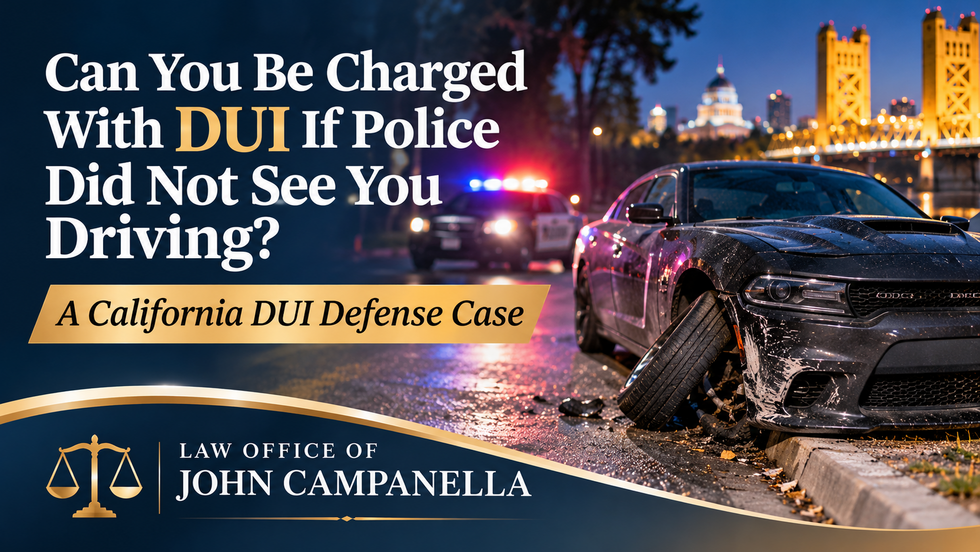
Consider an anonymized situation involving a damaged Dodge Charger, a driver waiting for a tow truck, a family member who arrives to help, and officers who arrive several hours after the vehicle becomes disabled. The person is outside the vehicle when officers make contact, has the keys in a pocket, and is later arrested for DUI.
The allegations include a BAC of 0.08% or higher and a separate allegation involving failure to present a driver's license. Blood and urine samples are collected after the arrest. The person also has an older driving-related history from Colorado.
These circumstances raise several legal questions. Was the person actually driving? When did the alleged driving occur? What does the chemical test establish about the person's condition at that time? How should the prior Colorado record be evaluated? And what happens to the driver's license while the criminal case is pending?
Can Police Charge Someone With DUI Without Seeing Them Drive?
Yes. An officer does not necessarily have to personally witness a person driving before a DUI arrest or prosecution can occur. The prosecution may rely on circumstantial evidence to establish that the person drove a vehicle.
However, the absence of an eyewitness officer can make the surrounding evidence especially important.
California Vehicle Code section 23152 addresses driving under the influence of alcohol or drugs. The prosecution must establish the elements of the particular DUI charge. A BAC allegation under section 23152(b), for example, does not eliminate the need to establish that the accused drove a vehicle.
When I evaluate a case in which officers arrived after a vehicle had already become disabled, I would want to know:
- Who last operated the vehicle?
- When did the vehicle strike the curb or become disabled?
- Did anyone actually see the person driving?
- Was the person found inside the vehicle or outside it?
- Where were the keys located?
- Were there witnesses who saw the vehicle before police arrived?
- What did the person tell officers?
- What did the officers independently observe?
- How much time passed between the alleged driving and the chemical test?
These questions help establish whether the evidence supports the prosecution's account or whether important parts of the timeline remain uncertain.
The Importance of the Timeline in a DUI Case
One of the most important issues in a delayed-contact DUI investigation is the timeline.
In the reported scenario, the vehicle allegedly struck a curb, causing a wheel to break. The person says a tow truck was requested but did not arrive despite waiting for several hours. A brother was then contacted and arrived to help with the disabled vehicle.
Officers reportedly arrived several hours after the vehicle became disabled. The person was outside the car, with the keys in a pocket, when the officers made contact.
That sequence raises a critical question: What evidence establishes that the person was driving at the time alleged by the prosecution?
Why the Timeline Matters
A chemical test performed after an arrest provides information about the sample at the time it was collected. When there is a significant delay between the alleged driving and testing, the timing and interpretation of the result may become important evidentiary issues.
I would want to compare the reported accident time, the tow-truck request, the brother's arrival, the officers' arrival, the arrest time, and the actual blood collection time.
These details should be established through records and evidence rather than assumptions. Dispatch records, tow-company records, telephone records, witness accounts, photographs, and police reports may help clarify the sequence.
Does Having Car Keys in Your Pocket Prove You Were Driving?
Not by itself. Possession of vehicle keys may be relevant evidence, but it does not automatically establish when or whether someone drove the vehicle.
In a case where a person is found outside a disabled vehicle, I would examine the location of the keys, the person's position, the condition of the vehicle, and any evidence showing who had control of the car before officers arrived.
The prosecution may argue that the keys and the damaged vehicle support an inference that the person had been driving. The defense should evaluate whether the remaining evidence supports that inference and whether other reasonable explanations are consistent with the available facts.
The important point is that one circumstance should not be treated as conclusive without considering the complete investigation.
What Does a BAC of 0.08% or Higher Actually Establish?
A BAC of 0.08% or higher is an important allegation in many California DUI cases. Under Vehicle Code section 23152(b), it is unlawful for a person to drive with a BAC of 0.08% or more, subject to the statute's requirements.
But a chemical test result must be evaluated in context.
In a delayed-contact case, I would want to know when the alleged driving occurred and when the blood sample was collected. Those times are not interchangeable.
A blood sample collected several hours after an alleged driving event may raise questions about how accurately the result reflects the person's BAC at the earlier time. The answer depends on the available evidence, the timing, the person's circumstances, and appropriate scientific analysis.
Why the Blood Collection Time Matters
Blood alcohol concentration can change over time as alcohol is absorbed and eliminated by the body. A later test result does not automatically establish the exact BAC at an earlier point.
Depending on the case, a qualified expert may need to evaluate:
- The time of the alleged driving.
- The time of the blood draw.
- The reported drinking timeline, if established by admissible evidence.
- The laboratory's analytical method and records.
- The integrity and handling of the blood sample.
- Whether retrograde extrapolation is scientifically appropriate and sufficiently supported.
I would not assume that a later blood result can simply be applied backward to the time of driving. Nor would I assume that a timing issue automatically defeats the prosecution's case. The scientific and factual evidence must be examined carefully.
Why Were Both Blood and Urine Samples Collected?
The reported circumstances indicate that blood and urine samples were collected at the jail after the arrest.
The reason for collecting both samples should be established from the arrest report, chemical-test advisement, laboratory paperwork, and any applicable testing records. It should not be assumed that the two samples were collected for the same purpose.
California's chemical-testing rules generally involve breath or blood testing for alcohol. Urine testing may be permitted in certain circumstances, including some drug-related investigations or when other testing options are unavailable or legally unsuitable.
In reviewing this part of a case, I would want to identify:
- What chemical test the officer initially requested.
- What advisements were given to the driver.
- Whether the driver agreed to the requested test.
- Why a urine sample was also collected.
- Whether the investigation involved suspected drugs as well as alcohol.
- What each laboratory test was designed to detect.
- Whether the collection and handling procedures were properly documented.
It is also important to distinguish a refusal to present a driver's license from a refusal to submit to a chemical test. They are different allegations and should not be confused.
What If the Driver Refused to Present a Driver's License?
The reported charge includes an allegation that the driver refused to present a driver's license to an officer.
This issue should be examined separately from the DUI allegation. California Vehicle Code section 12951 addresses the requirement to display a driver's license when requested by a peace officer under the circumstances covered by the statute.
Before evaluating the allegation, I would want to know the exact statute cited, what the officer requested, how the request was communicated, what the driver said or did, and whether the officer's report accurately describes the interaction.
It is also important to determine whether the allegation is a separate count, an infraction, or another type of alleged violation. The exact charging document and applicable statutory provision matter.
A failure-to-present-license allegation should not automatically be described as a chemical-test refusal. The legal consequences are different.
Does an Older Colorado DWAI Count as a Prior California DUI?
Another important issue in this scenario involves the person's reported Colorado driving history. The person describes an older DWAI and a separate misdemeanor from approximately ten years earlier and believes the prior matters should no longer count.
This requires careful legal analysis. It would be a mistake to assume that every out-of-state driving offense automatically counts as a California DUI prior. It would also be a mistake to assume that an offense cannot count simply because it happened in another state.
California's repeat-DUI sentencing provisions generally use a ten-year period for qualifying prior convictions. The nature of the prior offense, the date of the conviction, the date of the current offense, and the applicable statutory requirements all matter.
What Should Be Examined About the Colorado DWAI?
I would want to obtain the actual Colorado court records rather than rely only on the person's description of the old case.
The review should include:
- The exact Colorado statute under which the person was convicted, if there was a conviction.
- Whether the matter resulted in a conviction, dismissal, or another disposition.
- The date of the prior offense.
- The date of the prior conviction.
- The elements of the Colorado offense.
- Whether the offense legally qualifies as a prior under the applicable California statute.
- Whether the prosecution can properly establish the prior conviction.
The label DWAI is not enough to answer these questions. The legal elements and actual disposition of the Colorado case must be reviewed.
Important: Do not assume that a prior Colorado DWAI or misdemeanor is automatically excluded from consideration. The ten-year rule is not a simple rule based only on how long ago someone remembers the incident occurring. The precise conviction history and applicable California law must be examined.
The separate Colorado misdemeanor also needs to be identified. A prior misdemeanor unrelated to DUI does not automatically become a DUI prior. Its relevance depends on the actual offense and the issue for which the prosecution seeks to use it.
Can a DUI Case Be Challenged When the Vehicle Was Already Disabled?
Potentially, yes. A disabled vehicle and delayed police contact may create important factual questions, but they do not automatically establish a defense.
In a situation like this, I would want to examine several categories of evidence.
1. Tow-Truck Records
If the driver says a tow truck was requested several hours before officers arrived, the tow-company records may help establish the timeline.
Relevant material may include the original call, dispatch time, service request, estimated arrival, cancellation record, and any communications with the customer.
2. Telephone Records and Messages
Calls and messages to the brother, tow company, or other individuals may help establish when assistance was requested and when family members arrived.
These records may also help corroborate the account that the person was waiting for help rather than attempting to continue driving.
3. Photographs of the Dodge Charger
Photographs showing the broken wheel, damaged tire, curb impact, and the vehicle's final position may help explain why the car could not be driven.
Photographs taken close to the time of the incident may be particularly useful. Any available tow-yard photographs, repair records, or inspection records may also deserve review.
4. The Brother's Account
The brother reportedly arrived to help with the disabled vehicle and was also arrested.
His account may be relevant to the timeline, but it should be evaluated carefully. His own arrest, observations, statements, and potential involvement in the case may affect how his testimony is assessed.
I would want to know what he personally observed, when he arrived, whether he saw the vehicle's condition, and what happened when officers appeared.
5. Police Reports and Body-Worn Camera Footage
The officers' reports and recordings may help establish exactly what happened when they arrived.
I would examine whether the recordings show:
- The person's location when officers first made contact.
- Whether the vehicle was occupied.
- Where the keys were located.
- What the person said about the vehicle and tow truck.
- Whether the person admitted to driving.
- What the officers observed and when.
- How the driver's license request was made.
- What testing instructions and advisements were provided.
Video may not answer every question, but it can be an important part of evaluating whether the written reports accurately describe the encounter.
What Happens at the California DMV Hearing?
The criminal DUI case is only one part of the situation. A separate administrative proceeding may affect the person's California driving privilege.
When a driver is arrested for DUI and the applicable legal requirements are met, the DMV may initiate an Administrative Per Se (APS) action.
The DMV hearing is not a criminal trial. It focuses on specified administrative issues, which can include whether the officer had reasonable cause to believe the person was driving under the influence, whether the arrest or detention was lawful under the applicable rules, and whether the driver had a qualifying BAC or refused a required test.
That distinction is especially important in a case where the person disputes whether they were driving at all.
The DMV Deadline
The California DMV generally states that a driver has ten days from receiving the suspension or revocation order to request an APS hearing. The actual notice and the applicable procedural rules should be reviewed promptly.
In the reported scenario, the person says the driver's license was taken and an online DMV process was completed. The exact confirmation, request, and hearing records should be obtained to verify what was submitted and whether a hearing was properly requested.
The DMV's official DUI information is available here: California DMV – Driving Under the Influence.
Can Winning the DMV Hearing End the Criminal DUI Case?
Not automatically. The DMV proceeding and the criminal case are separate processes.
A favorable DMV decision may affect the administrative action against the driver's license. It does not, by itself, dismiss the criminal DUI charge.
Similarly, a favorable result in criminal court does not necessarily resolve every separate DMV issue. Each proceeding must be evaluated according to its own legal standards and evidence.
In a case involving disputed driving, the evidence presented in both proceedings should be reviewed consistently, while recognizing that the proceedings have different purposes and rules.
What Should Someone Do After an Arrest Involving Disputed Driving?
When the person disputes having driven or disputes the timing of the alleged driving, preserving evidence can be particularly important.
Evidence Preservation Checklist
- Keep all arrest paperwork and charging documents.
- Save tow-company call records and service-request information.
- Preserve relevant phone records and messages.
- Keep photographs of the damaged vehicle and broken wheel.
- Obtain repair, towing, and vehicle inspection records.
- Identify people who personally observed the vehicle or the events.
- Preserve any available surveillance or nearby business video before it is overwritten.
- Obtain the blood and urine laboratory records through the appropriate legal process.
- Keep the DMV suspension notice and hearing confirmation.
- Obtain certified records of any prior Colorado cases.
It is also important not to delete messages, alter photographs, or ask witnesses to change their accounts. Evidence should be preserved in its original form and reviewed through the appropriate legal process.
How a DUI Charge Can Affect Employment
A DUI arrest can create practical problems beyond the criminal case. These concerns can be especially serious for someone who recently started a second job or depends on driving to get to work.
Possible issues include:
- Difficulty commuting if the driving privilege is suspended.
- Transportation expenses while the case is pending.
- Employer policies involving driving or criminal charges.
- Potential requirements for a restricted license or ignition interlock device.
- Insurance complications.
A person should not assume that an arrest automatically results in job loss or that a particular driving restriction applies without reviewing the actual DMV and court orders.
Depending on eligibility and the circumstances, California may provide certain restricted-license or ignition-interlock options. These options have specific requirements and should be evaluated individually.
My Approach to Reviewing a DUI Case Involving a Disabled Vehicle
When I evaluate a DUI defense matter, I do not believe the analysis should begin and end with the BAC result or the officer's initial conclusion.
I want to understand what happened before the police arrived, what the officers actually observed, what the available records establish, and whether the evidence proves the charged offense.
In a case involving a disabled Dodge Charger, a broken wheel, a delayed tow truck, a family member who arrived to help, and an arrest made after officers arrived several hours later, I would focus on the following questions:
- Can the prosecution establish who was driving the vehicle?
- Can it establish when the alleged driving occurred?
- Does the physical evidence support the reported accident timeline?
- What do the tow-company and telephone records show?
- What do the officers' reports and recordings actually establish?
- Does the blood-test timing create a legitimate evidentiary issue?
- Was the urine collection legally appropriate under the circumstances?
- What is the exact legal basis for the separate driver's-license allegation?
- Do the older Colorado records qualify as prior convictions under California law?
- Were the criminal and DMV deadlines handled correctly?
These are not automatic defenses or promises of a particular outcome. They are the types of questions that can help determine whether the prosecution's evidence is sufficient and whether a legal challenge may be available.
Frequently Asked Questions
Can police arrest someone for DUI if they find the person outside the vehicle?
Yes, an arrest may occur based on the circumstances and available evidence. However, the prosecution must still establish the elements of the charged DUI offense. Whether the person was driving and when the driving occurred can become important disputed issues.
Does having the car keys in my pocket prove that I was driving?
Not by itself. Keys may be relevant circumstantial evidence, but they do not automatically establish who drove the vehicle or when. The complete circumstances must be considered.
Can a blood test collected hours after an accident be challenged?
Potentially. The time between the alleged driving and the blood collection may raise questions about what the result establishes at the earlier time. The laboratory records, testing procedures, timeline, and relevant scientific evidence should be reviewed.
Can a prior Colorado DWAI count as a California DUI prior?
It depends on the actual Colorado offense, its legal elements, the disposition, the dates, and the applicable California law. The name of the offense alone does not resolve the question.
Does refusing to show a driver's license mean I refused a DUI chemical test?
No. These are separate issues. A failure-to-present-license allegation should be distinguished from a refusal or failure to complete a required chemical test. The exact statute and police documentation should be reviewed.
Can the DMV suspend my license even if I have not been convicted?
Yes. California's APS process is separate from the criminal court case. The DMV may take administrative action following an arrest when the statutory requirements are met.
Will a successful DMV hearing dismiss my DUI charge?
No, not automatically. The DMV hearing concerns the administrative action against the driving privilege. The criminal DUI charge is handled separately by the court.
Should I keep records from the tow company and my family members?
Yes. If the driving timeline is disputed, tow-company records, phone records, photographs, and witness information may help establish what happened. Preserve original records and avoid altering them.
Speak With the Law Office of John Campanella About a California DUI Case
A DUI allegation involving a damaged vehicle, delayed police contact, disputed driving, a BAC result of 0.08% or higher, and an older out-of-state driving history can involve several separate legal questions.
I am John Campanella of the Law Office of John Campanella. My practice focuses on DUI defense and related driving matters. I examine the evidence, the applicable legal requirements, and the circumstances surrounding an arrest when evaluating possible defense issues.
If you are facing a DUI charge in Sacramento or elsewhere in California and there is a dispute about whether you were driving, when the alleged driving occurred, or how the chemical-test evidence should be interpreted, I encourage you to contact me.
You can also visit the Law Office of John Campanella website to learn more about my DUI defense practice.
Discuss Your DUI Defense Questions
If you have been arrested for DUI and have questions about the evidence, DMV proceedings, or possible defense options, contact the Law Office of John Campanella.

Comments
There are no comments for this post. Be the first and Add your Comment below.
Leave a Comment