
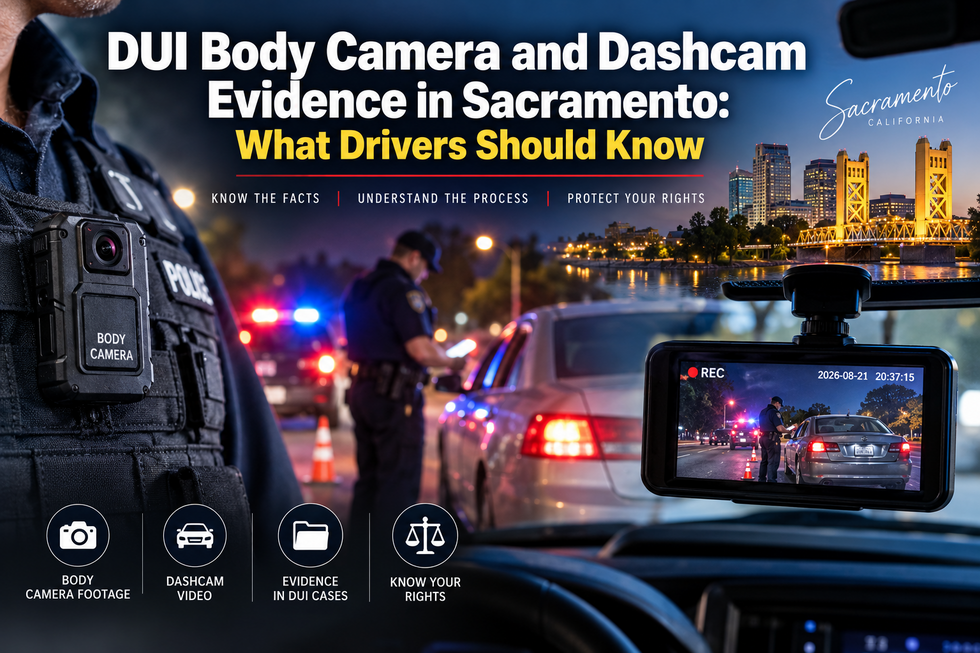
Video recordings can become an important part of a DUI investigation or criminal case in Sacramento. Depending on the circumstances, recordings may show portions of a traffic stop, an interaction between a driver and an officer, field sobriety testing, statements, driving behavior, or events surrounding an arrest.
But video evidence is only one part of a case. A recording does not automatically establish guilt or innocence, and the legal significance of a particular recording depends on what it shows, how it was preserved, whether it can be authenticated, and the other evidence involved.
California law also distinguishes between a criminal DUI case and a separate administrative action by the California Department of Motor Vehicles (DMV). Those proceedings can involve different issues and procedures.
What Is DUI Body-Camera and Dashcam Evidence?
Several types of video or audio recordings may potentially be relevant to a Sacramento DUI investigation.
Police Body-Worn Camera Footage
A body-worn camera, sometimes called a body camera or BWC, is a camera carried or worn by an officer. Depending on the agency, equipment, circumstances, and applicable policy, it may record video and audio during some portion of an encounter.
A body camera may capture an officer's interaction with a driver, statements made during the encounter, observations of physical behavior, or portions of an investigation.
It should not be assumed that every officer or agency uses the same equipment or records every interaction in the same way.
Police Vehicle Dashcam or In-Car Video
A patrol vehicle may also have a mobile video or audio recording system. These systems can capture views from the patrol vehicle and, depending on the equipment and activation, may include audio.
The California Highway Patrol's current General Order 100.61 governs its Wireless Mobile Video/Audio Recording Systems (WMVARS). The order states that these systems capture audio and video for law-enforcement purposes and can be used to document evidence, prepare reports, and assist with court testimony.
CHP policy should not be treated as the policy of the Sacramento Police Department or the Sacramento County Sheriff's Office. Sacramento-area agencies may have different equipment, policies, and procedures.
Other Official Recordings
Other recordings can potentially exist, depending on the circumstances. Examples could include recordings from other law-enforcement systems or video obtained during an investigation.
Whether a particular recording exists, whether it was preserved, and whether it can be obtained depends on the circumstances and the agency involved.
Private or Third-Party Video
A DUI investigation may also involve video from sources outside law enforcement. Examples could include:
- A driver's own dashcam
- A passenger's recording
- Business surveillance video
- Residential security-camera footage
- Traffic or roadway recordings
- Other recordings made by witnesses or third parties
The legal relevance of such footage depends on the facts of the particular case and applicable evidentiary rules.
What Can Video Capture During a DUI Investigation?
A recording may provide a visual or audio record of some portion of a DUI investigation. Depending on the camera, its position, when it was activated, and what happened, footage might capture:
- The traffic stop
- The reason given for the stop
- The driver's interaction with an officer
- Statements made during the encounter
- Driving behavior observed before or during the stop
- Field sobriety testing, if conducted
- Physical coordination or behavior
- Requests for chemical testing
- Portions of an arrest
- Events around the vehicle
- Interactions with passengers or witnesses
Video does not necessarily show everything that happened.
For example, a camera may have a limited field of view. Audio may be affected by distance, background noise, equipment limitations, or other circumstances. A recording may also begin after an event has already started or end before the entire encounter has concluded.
The CHP's current WMVARS policy recognizes that its video and audio recordings are not all-inclusive and may capture a less broad or less detailed image than the totality of human senses. This is one reason attorneys generally evaluate the complete recording rather than relying only on a short excerpt.
How Can Video Evidence Be Used in a DUI Case?
Video can potentially help establish what happened during an encounter.
- Support or contradict testimony
- Show statements made during an interaction
- Provide evidence of conduct or physical behavior
- Help establish a timeline
- Provide context for a written police report
- Be reviewed by prosecutors
- Be reviewed by defense counsel
- Become relevant to an evidentiary dispute
California Evidence Code section 351 provides that, subject to statutory exceptions, relevant evidence is admissible. Other evidentiary rules can still affect whether particular evidence is admitted and how it is used.
The important point is that the existence of video does not automatically determine the outcome of a DUI case.
Can Police Video Be Used in a California DUI Case?
Potentially, yes. But it is not accurate to say that body-camera footage or dashcam footage is automatically admissible simply because it was recorded by police.
California evidence law includes requirements concerning relevance and authentication. Evidence Code section 1400 defines authentication in terms of evidence sufficient to support a finding that the item is what its proponent claims it is.
California appellate decisions have also addressed authentication of photographs and video recordings. In People v. Goldsmith, the California Supreme Court explained that the foundation necessary to authenticate a photograph or video can vary according to the nature and purpose of the evidence.
Depending on the circumstances, questions may involve:
- Relevance
- Authentication
- Foundation
- Hearsay
- Constitutional issues
- Discovery obligations
- Potential prejudice or confusion
- The completeness and context of the recording
Therefore, saying that "police video is always admissible" would be too broad.
What If the Video Does Not Match the Police Report?
Sometimes a driver, prosecutor, or defense attorney may identify differences between a recording and a written report.
That can become relevant, but a difference does not automatically establish that an officer intentionally wrote a false report. It also does not automatically mean that DUI charges will be dismissed.
A recording may capture details that were not included in a report. Conversely, an officer's report may contain observations or information that are not visible or audible in a particular recording.
Attorneys may compare the recording with:
- The police report
- Officer testimony
- Witness statements
- Chemical-test evidence
- Field sobriety-test observations
- Other physical or documentary evidence
- Other available recordings
The significance of any inconsistency is ultimately fact-specific.
What If There Is No Body-Camera or Dashcam Video?
The absence of video does not automatically mean that a DUI case disappears.
It does not automatically mean:
- The driver wins
- The charges must be dismissed
- An officer cannot testify
- Other evidence cannot be considered
A DUI case can involve many forms of evidence besides video.
Whether potentially important missing footage matters in an individual case can depend on the circumstances, applicable law, the reason the footage is unavailable, and what other evidence exists.
California Penal Code section 1054.1 addresses specified criminal discovery obligations, including relevant real evidence and exculpatory evidence under the conditions described by the statute. The legal significance of missing, overwritten, destroyed, or unavailable evidence depends on the particular circumstances.
How Long Is DUI Video Retained?
There is no single California-wide answer that applies identically to every law-enforcement recording.
Retention can depend on:
- The law-enforcement agency
- The type of recording system
- Whether the recording is classified as evidence
- The nature of the event
- Applicable agency retention policies
- Whether the recording is connected to an investigation or proceeding
- Applicable state or local requirements
California Highway Patrol Example
CHP's current General Order 100.61, revised November 2025, states that WMVARS recorded evidence must be retained for not less than one year, with potentially longer retention periods depending on the type of event and the CHP Evidence Manual.
This CHP-specific retention information should not be generalized to every Sacramento-area agency.
Can a Driver Get a Copy of Body-Camera or Dashcam Footage?
Possibly, but the answer depends on the circumstances and the type of proceeding.
There are important differences between:
- A California Public Records Act request
- Criminal discovery in a pending case
- A DMV administrative proceeding
- Other legal requests for records
A person should not assume that a public-records request will automatically produce an unrestricted, unredacted copy of every recording.
Public-Records Requests
California public-records law can provide access to records held by public agencies, but exemptions and other restrictions can apply.
Sacramento County explains that public records can include recorded information in various forms, including pictures and sounds, and provides a process for submitting Public Records Act requests.
The existence of a public-records process does not mean every law-enforcement recording must be released without restriction.
Criminal Discovery
A different framework applies when a DUI charge has been filed and the recording is evidence relevant to the criminal case.
California Penal Code section 1054.1 requires disclosure of specified materials to the defendant or defense attorney when the statutory conditions are met, including relevant evidence and exculpatory evidence.
Body-Camera Video and Privacy
Police recordings can contain information about many people, not just the driver.
- The driver
- Passengers
- Witnesses
- Police officers
- Other motorists
- Pedestrians
- Bystanders
- People inside nearby businesses or residences
- Personal information communicated during the encounter
For that reason, a recording may be subject to redaction or other restrictions.
California Penal Code section 832.7 contains specific rules concerning certain peace-officer records and public disclosure, including circumstances involving redactions and protected information. The statute also addresses the relationship between disclosure provisions and California's criminal discovery process.
Dashcam vs. Body-Camera Evidence
| Feature | Body-Worn Camera | Police Vehicle Dashcam / In-Car Camera |
|---|---|---|
|
Location |
Worn by an officer |
Mounted in or associated with a patrol vehicle |
|
Typical view |
Closer view of the officer's interaction |
View from the patrol vehicle |
|
Audio |
May capture nearby conversations |
May include vehicle or microphone audio depending on the system |
|
Potential DUI relevance |
Driver interaction, statements, testing, behavior |
Driving observations, stop, vehicle position, interaction |
|
Limitations |
Camera angle, movement, activation and audio limitations |
Camera position, distance, field of view, activation and audio limitations |
Both types of recordings can potentially be useful. They may also provide different perspectives on the same event.
Can a Driver's Own Dashcam or Phone Video Be Used?
Potentially. A driver's dashcam, a passenger's recording, business surveillance footage, or another third-party recording may be relevant if it captures something material to the case.
A recording might document driving conditions, traffic conditions, the surrounding roadway, or part of an interaction.
The same evidentiary considerations can apply to privately created recordings. Questions can arise about what the recording shows, whether it is complete, whether it has been altered, and whether it can be authenticated.
If you have a potentially important recording, preserving the original is generally preferable to relying only on an edited or converted copy.
What Drivers Should Do After a DUI Arrest
If you are facing a DUI charge and believe video evidence may exist, practical steps can include:
Preserve Potentially Relevant Recordings
Do not intentionally delete, overwrite, alter, or destroy potentially relevant recordings.
Keep the Original File
If you have your own recording, preserve the original file when possible. Keep information about when and where it was recorded and what device recorded it.
Do Not Misrepresent an Edited Recording
If a recording has been edited for convenience, do not present the edited version as though it were the original.
Ask About Discovery
If criminal DUI charges have been filed, a qualified California criminal-defense attorney can evaluate what evidence may be available through the applicable discovery process.
Drivers who are facing a DUI charge and have questions about video evidence may want to discuss the specific circumstances of their case with a qualified California DUI attorney, such as the Law Office of John Campanella.
Remember That a DUI Case and DMV Action Are Separate Matters
A DUI arrest can involve both a criminal case and a separate DMV administrative proceeding.
The California DMV explains that its DUI-related administrative hearing concerns the driver's driving privilege and circumstances surrounding the arrest. It is separate from the criminal court proceeding that determines criminal liability.
Sacramento Agencies May Have Different Policies
Sacramento-area DUI investigations can involve different law-enforcement agencies depending on where the stop or arrest occurred.
- Sacramento Police Department
- Sacramento County Sheriff's Office
- California Highway Patrol
The applicable agency matters. A policy governing CHP's vehicle video system should not automatically be attributed to Sacramento Police Department or the Sacramento County Sheriff's Office.
CHP currently publishes policies concerning its Wireless Mobile Video/Audio Recording Systems, including activation, evidence handling, retention, and requests for recordings. Other agencies may have different procedures.
Important California Legal Distinctions
Criminal DUI Case
A criminal DUI case concerns alleged violations of California criminal law and proceeds through the criminal court system. Video can potentially become evidence in that proceeding, subject to applicable evidentiary and discovery rules.
DMV Administrative Action
A DMV action is separate from the criminal prosecution. The California DMV states that its Administrative Per Se process concerns the driver's driving privilege and is independent of criminal penalties imposed following a DUI conviction.
Evidence in Court
Evidence used in a criminal proceeding must satisfy applicable evidentiary requirements. Relevance, authentication, hearsay rules, constitutional issues, and other considerations can affect whether and how evidence is used.
Evidence in a DMV Proceeding
A recording can also potentially be relevant to a DMV administrative proceeding, but the DMV proceeding is governed by its own administrative framework.
Common Myths About DUI Video Evidence
Myth: "If there is no body-camera video, the DUI case is automatically dismissed."
Not necessarily. A DUI case may involve other evidence, including officer testimony, chemical-test evidence, witness testimony, documents, and other recordings.
Myth: "Everything recorded by police is automatically public."
Not necessarily. California law contains specific disclosure rules, exemptions, redaction provisions, and separate criminal-discovery requirements.
Myth: "A dashcam recording automatically proves who is telling the truth."
Not necessarily. Video can provide important evidence, but its interpretation depends on what it actually captures and the context surrounding the recording.
Myth: "Police video always shows the entire encounter."
No. Cameras can have limited fields of view, activation requirements, audio limitations, and other technical or operational limitations.
Myth: "A video can never be challenged in court."
Incorrect. Video evidence can raise questions concerning relevance, authentication, foundation, hearsay, completeness, constitutional issues, and other evidentiary matters.
Frequently Asked Questions
Can body-camera footage be used in a Sacramento DUI case?
Potentially. Relevant video can become evidence in a criminal DUI case, but whether particular footage is admissible and what weight it receives depends on the circumstances and applicable law.
Can a driver request police body-camera footage?
Potentially. A driver may have options involving a Public Records Act request, criminal discovery, or another legal process depending on the circumstances. A driver should not assume that an unredacted copy will automatically be released.
How long is DUI video kept?
There is no single retention period that applies to every Sacramento-area law-enforcement recording. Agency policy, recording type, event classification, and evidence status can affect retention.
What happens if body-camera footage is missing?
Missing footage does not automatically determine the outcome of a DUI case. Its significance depends on the circumstances, applicable law, preservation issues, and the other evidence in the case.
Can dashcam footage contradict a police report?
It can potentially show information that differs from or adds context to a written report. The significance of any difference is fact-specific.
Can my own dashcam video be used as evidence?
Potentially. A driver's own dashcam recording may be relevant if it captures information material to the case. The recording may still need to satisfy applicable evidentiary requirements.
Is police body-camera footage always available?
No. Whether footage exists can depend on the agency, equipment, activation, circumstances, and other factors. Even when footage exists, access may be subject to applicable restrictions.
Does video evidence automatically determine the outcome of a DUI case?
No. Video is one potential form of evidence. Its importance depends on what it shows and how it relates to the other evidence and legal issues in the case.
What should I do if I believe important video evidence exists?
Preserve any recording you already possess and avoid deleting or altering potentially relevant material. If you are facing a DUI charge, consider discussing the evidence and applicable discovery process with a qualified California attorney.
Can video evidence also matter in a DMV DUI proceeding?
Potentially. The DMV's DUI administrative process is separate from the criminal case, and evidence may be relevant to the issues considered in that proceeding.
The Bottom Line for Sacramento Drivers
DUI body-camera footage, police dashcam recordings, and other video can provide valuable information about what happened during a traffic stop or DUI investigation. But no single recording automatically establishes guilt, innocence, or the outcome of a case.
Important questions can include:
- What exactly does the recording show?
- When does it begin and end?
- Does it contain audio?
- Is the recording complete?
- Can it be authenticated?
- Does it differ from other evidence?
- Was it preserved?
- How can it lawfully be obtained?
- Is the issue part of a criminal case, a DMV proceeding, or both?
California law provides separate frameworks for evidence, criminal discovery, public records, and DMV administrative actions. Sacramento-area agencies may also have different policies and recording systems.
Anyone facing a DUI charge should consider obtaining case-specific advice rather than relying on general information about video evidence.
Safety Reminder
DON'T DRINK AND DRIVE.
If you have consumed alcohol or used an impairing substance, use a sober driver, taxi, rideshare, or another safe transportation option.
Disclaimer
This article provides general educational information about DUI video evidence in California and is not legal advice. DUI cases are fact-specific, and laws and agency policies can change. Anyone facing a DUI charge should consider consulting a qualified California attorney for advice about their individual situation.
Sources
California Legislative Information: California Penal Code § 832.7; California Penal Code § 1054.1; California Evidence Code § 351; California Evidence Code § 1400.
California Courts: California Rules of Court, Rule 2.1040; California Supreme Court decision in People v. Goldsmith.
California Department of Motor Vehicles: DUI information and Administrative Per Se information concerning the distinction between DMV administrative proceedings and criminal DUI cases.
Sacramento County: Public Records Act request information.
California Highway Patrol: General Order 100.61 concerning Wireless Mobile Video/Audio Recording Systems.
California Highway Patrol: Highway Patrol Manual 70.1, Chapter 15, concerning storage and retention of departmental video/audio recordings.

Comments
There are no comments for this post. Be the first and Add your Comment below.
Leave a Comment