
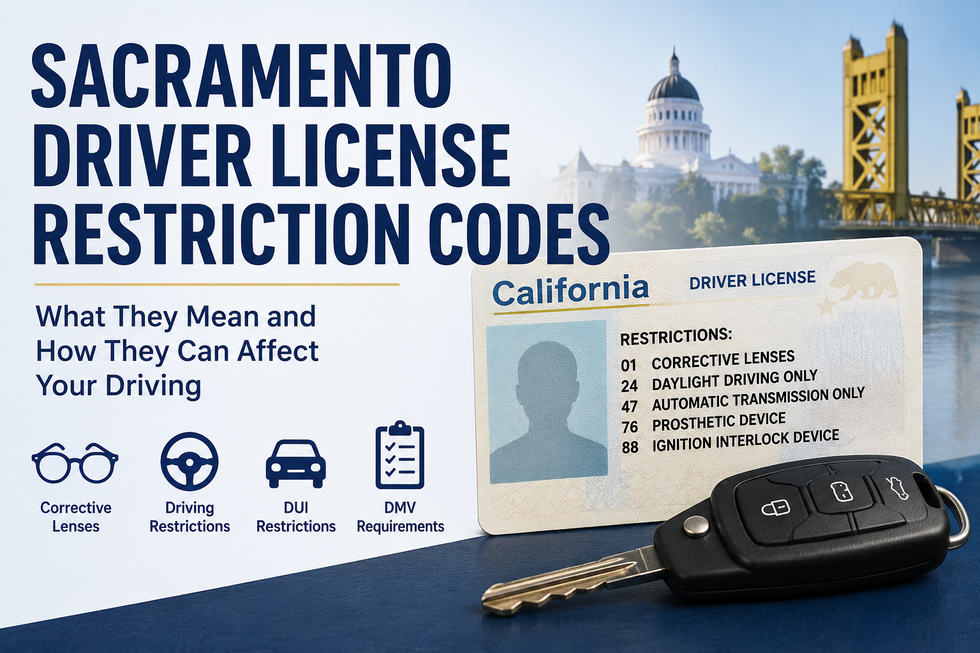
If you recently looked at your California driver's license and noticed a restriction code, you're not alone. Many Sacramento drivers are surprised to find a letter or code on their license without fully understanding what it means. In many cases, these restrictions are simple requirements, such as wearing glasses while driving. In other situations, they may be connected to a medical condition, a physical limitation, or a DUI-related license restriction.
Understanding your driver license restriction is important because failing to follow it can lead to traffic citations, DMV penalties, or additional legal issues. Whether you are applying for your first California driver's license, renewing your license, or trying to restore your driving privileges after a DUI, knowing what your restriction means can help you avoid unnecessary problems.
This guide explains California driver license restriction codes in simple language. You'll learn why restrictions are issued, what the most common codes mean, how they affect Sacramento drivers, and what steps you can take if you believe a restriction should be removed.
What Are California Driver License Restriction Codes?
A driver license restriction is a condition placed on your California driver's license by the California Department of Motor Vehicles (DMV). These restrictions allow a person to drive only if they meet certain requirements.
Unlike a suspended license, a restricted license does not automatically prevent you from driving. Instead, it limits how, when, or under what conditions you may legally operate a vehicle.
For example, your license may require you to:
- Wear corrective lenses while driving.
- Use an Ignition Interlock Device (IID).
- Drive only vehicles equipped with adaptive equipment.
- Wear a hearing aid if necessary.
- Drive only during daylight hours.
These restrictions are intended to improve road safety while allowing drivers to maintain their independence whenever possible.
Why Does the California DMV Place Restrictions on a Driver's License?
The California DMV reviews several factors before adding a restriction to a driver's license. The purpose is not to punish drivers but to ensure they can safely operate a motor vehicle.
Common reasons include:
Vision Problems
If you need glasses or contact lenses to meet California's vision requirements, the DMV may require you to wear them whenever you drive.
Medical Conditions
Certain medical conditions may affect your ability to drive safely. Depending on your situation, the DMV may require medical documentation or place restrictions on your license.
Physical Disabilities
Drivers who use adaptive driving equipment may receive restrictions requiring that equipment whenever they operate a vehicle.
DUI Convictions
Following certain DUI convictions, the DMV may issue a restricted license that allows limited driving privileges after specific legal requirements have been met.
Driving Test Results
If a DMV examiner determines that you can safely drive only under certain conditions, your license may include restrictions based on your driving evaluation.
Common California Driver License Restriction Codes
Although California has several restriction codes, most drivers encounter only a few during their lifetime.
The table below explains some of the most common restrictions.
| Restriction | What It Means |
|---|---|
|
Corrective Lenses |
Glasses or contact lenses must be worn while driving. |
|
Outside Rearview Mirrors |
Vehicle must have additional outside mirrors. |
|
Automatic Transmission |
Driver may operate only vehicles with an automatic transmission. |
|
Daylight Driving |
Driving is limited to daylight hours. |
|
Hearing Aid |
Hearing aid must be worn while driving if required. |
|
Prosthetic Device |
Required prosthetic or assistive device must be used while driving. |
|
Adaptive Equipment |
Driver must use approved adaptive equipment such as hand controls. |
|
Ignition Interlock Device (IID) |
Driver must operate only vehicles equipped with an approved IID when required. |
Not every California driver will receive a restriction. Restrictions are based on each person's individual circumstances.
What Does Each Restriction Mean?
Let's look more closely at the restrictions Sacramento drivers are most likely to encounter.
Corrective Lenses Required
This is one of the most common restrictions issued by the California DMV.
If you need glasses or contact lenses to meet the state's vision standards, your driver's license will require you to wear them whenever you drive.
Driving without corrective lenses could result in a citation if law enforcement determines you are violating your license restrictions.
Outside Rearview Mirrors Required
Drivers with limited neck movement or reduced peripheral vision may be required to drive vehicles equipped with both left and right outside mirrors.
These mirrors improve visibility and help compensate for physical limitations.
Automatic Transmission Only
Some drivers complete their driving test using an automatic transmission vehicle or have medical conditions that make operating a manual transmission difficult.
In those situations, the DMV may restrict the driver to automatic transmission vehicles.
Daylight Driving Restriction
Certain eye conditions make driving at night more difficult or unsafe.
If the DMV determines that your vision is adequate only during daylight hours, your license may include a daylight driving restriction.
This restriction helps reduce the risk of nighttime crashes caused by poor visibility.
Hearing Aid Requirement
Drivers with significant hearing loss may be required to wear hearing aids while operating a vehicle.
This allows drivers to hear emergency vehicles, warning signals, and surrounding traffic more effectively.
Prosthetic Device Requirement
If you use an artificial limb or another assistive device to drive safely, the DMV may require that device whenever you are behind the wheel.
Removing or failing to use the required device while driving could violate your license restrictions.
Adaptive Equipment Restriction
Some drivers rely on specially modified vehicles.
Examples include:
- Hand controls
- Steering wheel spinner knobs
- Left-foot accelerators
- Pedal extensions
- Wheelchair-accessible driving equipment
The restriction simply means the driver must continue using approved adaptive equipment while operating a vehicle.
Ignition Interlock Device (IID) Restriction
Many Sacramento drivers become familiar with this restriction after a DUI conviction.
An Ignition Interlock Device requires the driver to provide a breath sample before starting the vehicle. If alcohol is detected above the preset limit, the vehicle will not start.
California law allows many eligible drivers to regain limited driving privileges after installing an IID and meeting other DMV requirements.
Sacramento DUI Cases and License Restrictions
Many people searching for driver license restriction codes are dealing with a DUI-related issue.
After certain DUI arrests or convictions, the California DMV may suspend your driving privilege. Depending on your eligibility, you may be able to obtain a restricted license instead of waiting through the entire suspension period.
A DUI-related restricted license may require you to:
- Install an Ignition Interlock Device.
- File proof of financial responsibility, often through an SR-22 insurance filing.
- Complete a state-approved DUI education program.
- Pay all required DMV reinstatement fees.
- Follow any additional court or DMV requirements.
Each case is different. The type of restriction depends on factors such as prior DUI convictions, the facts of the case, and whether all legal requirements have been satisfied.
Restriction Codes vs. Restricted Licenses
Many Sacramento drivers confuse these two terms, but they are not the same.
| Driver License Restriction | Restricted Driver License |
|---|---|
|
A condition placed on a driver's license. |
A limited driving privilege issued by the DMV. |
|
May apply for medical, vision, or equipment reasons. |
Often issued after certain DUI-related suspensions. |
|
Can remain for years or permanently. |
Usually temporary until reinstatement requirements are completed. |
|
Example: Wear corrective lenses. |
Example: Drive only after installing an IID. |
Understanding the difference helps drivers know exactly what requirements apply to their situation.
How Do You Know If Your License Has a Restriction?
Many drivers discover a restriction only after receiving a new driver's license.
You can usually find your restriction by:
- Looking at the front of your California driver's license.
- Reviewing your DMV driving record.
- Reading DMV correspondence regarding your license.
- Contacting the California DMV for clarification if you are unsure.
If you do not understand a restriction listed on your license, it is always better to ask questions before driving rather than risk violating DMV requirements.
What Happens If You Ignore a Driver License Restriction?
Ignoring a restriction can create problems that are often more serious than many drivers expect.
Depending on the circumstances, violating a license restriction may result in:
- A traffic citation.
- Additional DMV action against your license.
- Fines and court costs.
- Increased insurance premiums.
- Difficulty restoring full driving privileges after a DUI.
- Additional legal consequences if you are involved in a traffic collision.
For example, a driver required to wear corrective lenses who chooses to drive without them may be cited during a traffic stop. Likewise, a driver whose restricted license requires an Ignition Interlock Device could face additional penalties for operating a vehicle that is not equipped with the required device.
Real-Life Example
Imagine that John, a Sacramento resident, recently completed the requirements to obtain a restricted license after a DUI conviction. He installed an Ignition Interlock Device, completed his required paperwork, and legally resumed driving.
A few weeks later, he borrowed a friend's vehicle that did not have an IID installed. During a routine traffic stop, the officer discovered that John's license required him to drive only vehicles equipped with an Ignition Interlock Device. Although John had a valid driver's license, he was still violating the conditions of his restricted driving privilege.
This example shows why understanding your license restrictions is just as important as having a valid driver's license.
How to Remove a California Driver License Restriction
Many Sacramento drivers ask whether a restriction can be removed from their driver's license. The answer depends on why the restriction was added in the first place.
Some restrictions remain in place for many years, while others can be removed after you meet California DMV requirements.
The DMV reviews each case individually. Simply requesting that a restriction be removed does not guarantee approval.
Below are the most common situations.
Step 1: Identify Why the Restriction Was Issued
Before taking any action, determine why your license was restricted.
Restrictions may have been issued because of:
- A failed vision screening
- A medical condition
- A physical disability
- A DUI-related license action
- A driving performance evaluation
- A court or DMV order
Understanding the reason behind the restriction helps you determine what documentation or testing may be required.
Step 2: Schedule a DMV Appointment
If you believe your restriction no longer applies, schedule an appointment with the California DMV.
Depending on your situation, the DMV may ask you to:
- Complete a vision examination.
- Submit updated medical records.
- Take a written knowledge test.
- Complete a behind-the-wheel driving test.
- Provide documentation showing you completed DUI requirements.
The exact process varies depending on the restriction.
Step 3: Complete Any Required Medical Evaluation
If your restriction is related to a medical condition, the DMV may require your physician to complete medical evaluation forms.
Examples include:
- Vision improvements after cataract surgery
- Recovery from an illness
- Improved mobility
- Physical rehabilitation
- Changes in medications
The DMV reviews the medical information before deciding whether the restriction should remain.
Step 4: Complete DUI Requirements
If your restriction is related to a DUI, you generally must complete every requirement before your driving privileges can be fully restored.
These requirements may include:
- Completing a state-approved DUI education program
- Filing proof of financial responsibility (such as an SR-22 if required)
- Paying DMV reinstatement fees
- Completing the required suspension or restriction period
- Installing and maintaining an Ignition Interlock Device when required
Missing even one requirement can delay the reinstatement process.
Step 5: Receive an Updated Driver's License
Once the DMV determines you have satisfied all requirements, it may issue a new driver's license without the restriction or with updated driving privileges.
Always review your new license carefully to confirm the information is accurate before driving.
DUI-Related Driver License Restrictions
Many Sacramento drivers first learn about license restrictions after a DUI arrest or conviction.
California has separate administrative actions through the DMV and criminal proceedings through the court. Even if your criminal case is resolved, the DMV may still require you to complete additional steps before restoring your driving privileges.
Depending on your circumstances, DUI-related restrictions may include:
- Driving only vehicles equipped with an Ignition Interlock Device
- Maintaining proof of financial responsibility
- Completing a DUI education program
- Following all DMV reinstatement requirements
Every DUI case is different. Factors such as prior convictions, blood alcohol concentration, refusal allegations, and court orders can affect your driving privileges.
Can Police See Driver License Restrictions?
Yes.
During a lawful traffic stop, law enforcement officers can review your driver's license information, including any applicable restrictions.
If an officer believes you are violating a restriction, you may receive a citation or face additional legal consequences depending on the circumstances.
For example:
- Driving without required corrective lenses
- Driving a manual transmission vehicle when restricted to automatic vehicles
- Operating a vehicle without an Ignition Interlock Device when one is required
Following your restrictions every time you drive is the safest way to avoid additional problems.
Will a Restriction Affect My Car Insurance?
A standard license restriction does not automatically increase your insurance premiums.
However, the underlying reason for the restriction may affect insurance costs.
For example:
- A vision restriction generally does not increase insurance rates.
- A DUI-related restriction may result in significantly higher premiums.
- Multiple traffic violations or license actions can also affect insurance costs.
Insurance companies consider many factors when determining premiums, including your driving history.
Can You Drive Outside California With a Restricted License?
California driver's licenses are generally recognized throughout the United States.
However, your restrictions continue to apply even when driving in another state.
For example, if your California license requires:
- Corrective lenses
- Adaptive driving equipment
- A hearing aid
- An Ignition Interlock Device
you are still expected to comply with those restrictions while driving outside California.
Ignoring a restriction while traveling could create legal issues if you are stopped by law enforcement.
Common Mistakes Drivers Make
Many drivers unintentionally violate their license restrictions.
Some of the most common mistakes include:
Assuming the Restriction Was Removed
Never assume a restriction has been lifted until the California DMV officially updates your driving record and issues an updated license.
Borrowing the Wrong Vehicle
Drivers with adaptive equipment or IID requirements sometimes borrow vehicles that do not meet their license restrictions.
Even if the vehicle is legally registered, driving it may violate your license conditions.
Missing DMV Deadlines
Failing to submit required paperwork or complete DUI education programs on time may delay reinstatement.
Ignoring Medical Reporting Requirements
Some medical conditions require updated documentation before the DMV will reconsider restrictions.
Providing accurate and timely information can help avoid unnecessary delays.
What is a California driver license restriction?
A driver license restriction is a condition placed on your license that limits how or under what circumstances you may legally drive.
Does a restriction mean my license is suspended?
No.
A restricted license allows you to drive under specific conditions. A suspended license generally removes your legal driving privilege until reinstatement requirements are met.
Can I remove a corrective lenses restriction?
Possibly.
If your vision improves, the DMV may require you to pass a new vision examination before removing the restriction.
What happens if I drive without following my restriction?
Depending on the situation, you could receive a citation, face DMV penalties, or encounter additional legal consequences.
Are DUI restrictions permanent?
Not necessarily.
Many DUI-related restrictions are temporary and may be removed after all court and DMV requirements have been completed.
Can I appeal a DMV decision?
In some situations, drivers may have options to request a review or hearing regarding DMV actions.
The available options depend on the specific circumstances of your case.
Can older drivers receive license restrictions?
Yes.
The DMV may place restrictions on drivers of any age if medical evaluations or driving assessments indicate they are necessary for safe driving.
Can adaptive equipment restrictions be removed?
Sometimes.
If your physical condition changes, the DMV may review updated medical information and determine whether the restriction should remain.
Can I drive someone else's vehicle?
Only if that vehicle complies with every restriction listed on your driver's license.
For example, if your license requires an Ignition Interlock Device or adaptive equipment, the vehicle must meet those requirements.
Will employers see my restriction?
Some employers that review driving records for job-related driving positions may learn about applicable license restrictions.
Requirements vary depending on the employer and the position.
When Should You Contact a Sacramento DUI Attorney?
While many driver license restrictions are straightforward, others involve complicated DMV procedures and legal issues.
You may benefit from speaking with a Sacramento DUI attorney if:
- Your driver's license was suspended after a DUI arrest.
- You were denied a restricted license.
- You disagree with a DMV decision.
- You need help understanding DMV hearing procedures.
- Your license was restricted because of a medical condition.
- You are trying to restore your full driving privileges.
An experienced attorney can review your situation, explain your legal options, and help you understand the next steps based on your individual circumstances.
Tips for Sacramento Drivers
If your California driver's license includes a restriction, following a few simple habits can help you avoid unnecessary complications.
- Read your driver's license carefully after every renewal.
- Follow every restriction listed on your license.
- Keep required medical devices or adaptive equipment in good working condition.
- Complete DMV requirements before applicable deadlines.
- Maintain required insurance documentation when necessary.
- Never assume a restriction has been removed until the DMV confirms it.
Being proactive can help protect both your driving privileges and your safety on the road.
Final Thoughts
Driver license restriction codes are designed to promote safe driving—not to prevent people from driving altogether. For many Sacramento residents, a restriction simply means taking reasonable steps, such as wearing corrective lenses or using approved adaptive equipment. For others, particularly those recovering driving privileges after a DUI, restrictions provide a path back to legal driving while meeting California DMV requirements.
The most important thing you can do is understand exactly what your license requires. If you have questions about a restriction, need help restoring your driving privileges, or are facing a DUI-related license issue, taking action early can help you avoid additional penalties and move forward with confidence.
Disclaimer: This article is for general educational purposes only and does not constitute legal advice. California laws and DMV procedures may change over time, and every case is unique. If you need legal advice about your specific situation, consult a qualified California DUI attorney.

Comments
There are no comments for this post. Be the first and Add your Comment below.
Leave a Comment