
California Commercial Driver License Guide
California Vehicle Code §12810.5: Higher Point Thresholds for Class A Drivers
A DMV Notice of Probation/Suspension can threaten a commercial driver's livelihood. However, the point calculation, applicable statutory thresholds, hearing rights, and potential stay deserve careful review before assuming a suspension is unavoidable.
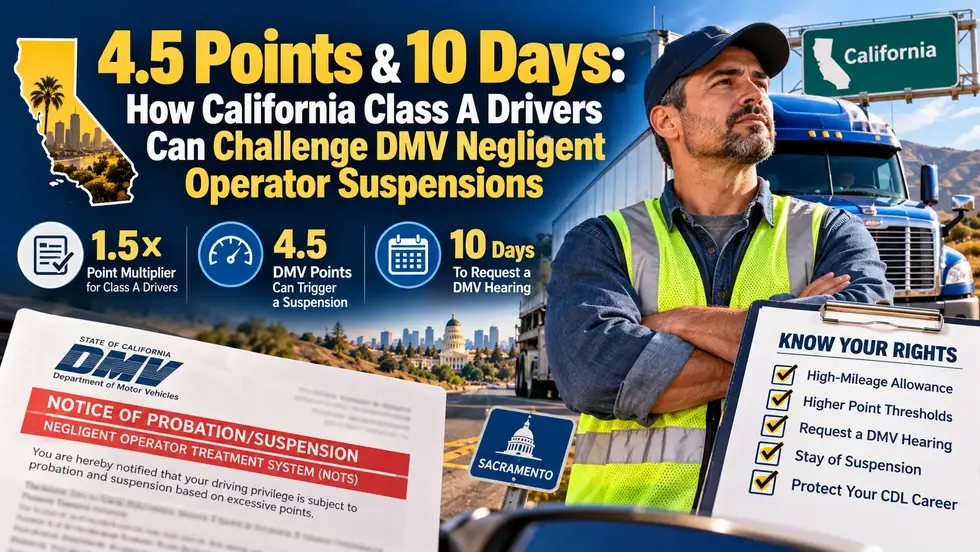
For a professional truck driver, a driver's license is more than a way to get from one place to another. It may be the legal foundation of a job, a source of family income, and a requirement for maintaining a commercial driving career. That is why a California Department of Motor Vehicles (DMV) negligent operator notice can be alarming.
A driver who receives a notice referencing the Negligent Operator Treatment System (NOTS) may assume that the DMV has already made an irreversible decision. In reality, California provides an administrative process through which eligible drivers can challenge an action, examine their driving records, present relevant evidence, and ask the DMV to reconsider the outcome.
For qualifying Class A and Class B drivers, California Vehicle Code (CVC) §12810.5 contains special rules concerning negligent-operator point thresholds. These rules are important, but they are not automatic exemptions. Eligibility depends on the driver's license and endorsement status, the source and timing of the points, and compliance with the statutory hearing requirements.
1.5×
The multiplier for qualifying violations attributed to operation of a vehicle requiring a Class A or Class B license.
10 Days
A critical hearing-request deadline for certain DMV actions. Check the exact instructions and deadline on your notice.
6 / 8 / 10
The 12-, 24-, and 36-month point thresholds for qualifying Class A and Class B drivers under §12810.5(b).
1. What Is a DMV Negligent Operator Notice?
California's Negligent Operator Treatment System is designed to identify drivers whose records show a pattern of traffic violations, collisions, or other driving-related concerns. Depending on the driving record and applicable rules, the DMV may issue warnings, a notice of intended action, or an order involving probation and suspension.
A document described as a PROB/SUS or Order of Probation/Suspension should be read carefully. The exact document title, mailing date, effective date, hearing instructions, and current license status matter. Do not assume that every DMV letter is merely a proposal, and do not assume that every letter means the suspension is already in effect.
Under the DMV's published NOTS guidance, a Level III order ordinarily includes one year of probation and a six-month suspension. The DMV states that this action generally becomes effective 34 days after the order is mailed. Review your own notice to confirm the dates and instructions that apply to your case.
Important distinction: A NOTS hearing is an administrative DMV proceeding concerning driving privileges. It is separate from a traffic-court case challenging an underlying citation. A result in one process does not automatically decide the other.
2. The 4.5-Point Calculation: Why Commercial Drivers Must Check the Details
Commercial drivers can face a different point calculation when a qualifying violation is attributable to operating a vehicle that requires a Class A or Class B license. Under CVC §12810.5(b)(2), each point assigned under §12810 is valued at one and one-half times its usual value for a violation the DMV reasonably determines is attributable to the operation of a qualifying commercial vehicle.
That multiplier can turn three qualifying one-point violations into a total of 4.5 points. The calculation must be based on the actual violations, their point values, whether the DMV can attribute them to qualifying commercial-vehicle operation, and whether the convictions have been correctly entered on the driving record.
| Illustrative record entry | Base value | Multiplier | Total |
|---|---|---|---|
|
Qualifying one-point violation 1 |
1 point |
× 1.5 |
1.5 points |
|
Qualifying one-point violation 2 |
1 point |
× 1.5 |
1.5 points |
|
Qualifying one-point violation 3 |
1 point |
× 1.5 |
1.5 points |
|
Total, if all assumptions apply |
3 base points |
— |
4.5 points |
This example illustrates the arithmetic only. It does not establish that a particular citation carries one point or that the DMV must apply the multiplier in every case. Verify the point value and commercial-vehicle attribution against the applicable law and the driver's actual record.
Do traffic tickets immediately become DMV points?
Not necessarily. A citation, a court disposition, and a point entry on the DMV record are different things. A ticket may still be pending, may have been adjudicated, or may have been reported to the DMV. Obtain the current driving record and compare it with court records and the notice.
If the DMV calculation appears to include a duplicate entry, the wrong disposition, a misidentified driver, or an incorrect point value, gather documents that substantiate the discrepancy. A challenge to the calculation should be supported by evidence.
3. The Higher Point Threshold for Eligible Class A and Class B Drivers
The general negligent-operator thresholds under CVC §12810.5(a) are four or more points within 12 months, six or more within 24 months, or eight or more within 36 months. The statute provides a different threshold structure for certain Class A and Class B drivers who request and appear at a DMV hearing.
| Measurement period | General threshold | Qualifying Class A/B threshold |
|---|---|---|
|
12 months |
4 or more points |
6 or more points |
|
24 months |
6 or more points |
8 or more points |
|
36 months |
8 or more points |
10 or more points |
The higher threshold is not a blanket immunity for commercial drivers. Under the statute, it applies only when the driver satisfies the relevant conditions, including requesting and appearing at a NOTS hearing. Certain certificates and endorsements are excluded, and the higher threshold does not apply if the DMV reasonably determines that the driver has reached the specified lower point totals through operation of a vehicle requiring only a Class C license without a qualifying certificate or endorsement, or a Class M license.
Why 4.5 points may not tell the whole story
Suppose a driver has 4.5 points in a 12-month period, and those points are attributable to qualifying Class A vehicle operation. The general threshold is four points in 12 months, while the higher statutory threshold for a qualifying Class A or B driver is six points in 12 months.
That difference may be significant. However, it does not by itself establish that the driver is entitled to dismissal of a NOTS action. The driver must check the eligibility requirements, all relevant point windows, the source of the points, and the precise basis for the DMV's action. The DMV may also consider the driver's record and other evidence at the hearing.
Important: Do not rely on the commercial threshold without reviewing the entire record. A driver can have points from commercial and noncommercial driving, different totals across different time windows, or a certificate or endorsement that changes the analysis.
4. High Mileage Is a Separate Issue Under §12810.5(a)
Commercial drivers sometimes hear that high annual mileage automatically allows them to accumulate more points. That description is too broad. CVC §12810.5(a) directs the DMV, when the driver requests and appears at a hearing, to give due consideration to the amount of use or mileage traveled in operating a motor vehicle.
This is separate from the higher Class A/Class B point thresholds in subdivision (b). The law does not establish a simple universal formula granting a fixed number of additional points for every number of miles driven. Mileage is a factor the DMV must consider in the statutory hearing context; it is not a guarantee that an action will be cancelled.
How to document mileage meaningfully
If mileage is relevant to the case, supporting records may include employer trip logs, dispatch records, electronic logging device reports, odometer records, delivery records, and other reliable documents showing the extent of driving. Explain why the records matter instead of submitting a large collection of paperwork without context.
High mileage should not be presented as permission to drive unsafely or as proof that traffic violations are harmless. The purpose is to give the DMV a complete, accurate picture of the driver's driving exposure and circumstances, alongside other relevant evidence.
5. The 10-Day Deadline: Why Immediate Action Matters
When a DMV notice gives a deadline to request a hearing, treat it as urgent. Read the notice on the day it arrives, identify the stated deadline, and use the DMV's specified method to request the hearing. Keep a copy of the request and any confirmation or proof of submission.
California DMV materials describe a 10-day hearing-request deadline for certain driver-safety actions. Because deadlines and procedures can depend on the specific action and notice, follow the document's instructions and promptly confirm the applicable deadline with the relevant Driver Safety Office or qualified counsel.
What a timely hearing request can accomplish
A hearing request preserves the opportunity to present evidence and contest the DMV action. It also matters for the stay process. Under the DMV's NOTS hearing guidance, if a hearing request is received within the allowed timeframe and a hearing cannot be held before the order's effective date, the DMV will grant a stay in the circumstances described in its guidance.
A stay is not the same as winning the hearing. It is a procedural protection while the matter is pending, subject to applicable exceptions. The DMV states that a stay is not granted in a NOTS case when evidence of a physical or mental condition presents an immediate driving risk and action has been taken under CVC §13953.
Practical rule: Do not assume that a hearing request, voicemail, or incomplete online submission automatically protects your license. Follow the instructions for your notice, confirm receipt, and verify the status of your driving privilege.
6. How to Prepare a NOTS Hearing Request and Defense
A useful hearing strategy starts with identifying the precise basis for the action. The goal is not simply to state that a commercial driver's job depends on driving. The goal is to present accurate evidence relevant to the point calculation, the driver's statutory eligibility, and the factors the hearing officer is authorized to consider.
- Read the entire notice. Identify the action level, mailing date, effective date, hearing deadline, contact details, and instructions about requesting a stay or submitting evidence.
- Obtain and review the DMV driving record. Compare listed violations, convictions, collisions, dates, and point totals with court dispositions and your own records. Identify errors that can be documented.
- Calculate the points across all relevant periods. Check the 12-, 24-, and 36-month windows. Determine which violations are attributed to commercial-vehicle operation and whether the multiplier has been applied appropriately.
- Evaluate Class A/Class B eligibility. Review CVC §12810.5(b), including excluded certificates and endorsements and the restriction involving point totals from Class C or Class M driving.
- Submit the hearing request on time. Use the method specified by the DMV and retain proof of submission. Ask the DMV to confirm the hearing date and the status of any applicable stay.
- Organize evidence and a focused explanation. Prepare the driving record, court paperwork, relevant work and mileage documentation, and evidence addressing inaccuracies or mitigating circumstances.
- Attend the hearing and respond to the issues raised. Be prepared to address the point count, driving history, commercial threshold requirements, and supporting evidence. Failure to appear can jeopardize the opportunity to contest the action.
7. What Evidence Can Matter at the Hearing?
The DMV says NOTS hearings can consider the correctness of the driving record, driving history, collision responsibility, mitigating circumstances, relevant physical or mental conditions, and steps taken to improve future driving behavior. The hearing officer must support the action with sufficient evidence.
Depending on the facts, potentially useful materials may include:
- A current DMV driving record and a written point calculation.
- Reliable court dispositions for relevant citations.
- Documents showing a citation or disposition was entered incorrectly, if that is genuinely at issue.
- Commercial vehicle assignment records, dispatch documents, and mileage logs relevant to the operation of a Class A or B vehicle.
- Evidence addressing a collision's circumstances or disputing responsibility, when a collision is part of the record.
- Specific corrective measures, such as relevant driver training or a documented plan to prevent repeat violations.
- Evidence of mitigating circumstances the driver wants the hearing officer to consider.
Not every item will be relevant in every case. Evidence should be truthful, organized, and tied to an issue the DMV can decide. A general statement that suspension would cause financial hardship may provide context, but it does not automatically defeat the statutory point count or establish eligibility for the higher commercial threshold.
8. Can a Driver Keep Working While the Hearing Is Pending?
The answer depends on the driver's current legal status and whether a stay or other applicable order protects the driving privilege. If the DMV grants a stay, its published guidance states that it may not take action against the driving privilege until the hearing has been held, subject to the stated exceptions.
Drivers should not infer from the existence of a hearing request alone that they are authorized to operate a commercial vehicle. Before driving, verify the status of the license and any stay or restriction directly with the DMV or through qualified legal counsel. Commercial driving may also involve separate employer, insurance, carrier, and federal qualification requirements.
If the suspension becomes effective, do not continue driving based on an assumption that the hearing request is still pending. Driving while a license is suspended can create additional legal and employment consequences.
9. What Happens If the DMV Upholds the Action?
A NOTS hearing can result in several outcomes, including sustaining the original action, modifying probation or suspension, imposing probation or restrictions, or setting the action aside when the evidence does not support it. The DMV's published hearing guidance describes these possible decisions.
If the original action is upheld, review the written decision carefully. Evaluate the findings, effective date, restrictions, and any available review process. The DMV states that a review requested within 15 days of a NOTS hearing decision may require a stay when the review cannot be completed before the effective date, under the circumstances described in CVC §14105.5.
Do not assume every adverse decision has the same review deadline or that requesting review automatically reverses the suspension. The written decision and applicable rules should control the next steps.
10. Common Mistakes That Can Weaken a Commercial Driver's Case
- Ignoring the notice: Missing a hearing deadline can reduce the opportunity to challenge the action.
- Assuming 4.5 points automatically qualifies for relief: The total must be assessed under the correct time windows, point rules, and eligibility conditions.
- Confusing mileage consideration with the higher commercial threshold: These are distinct legal considerations.
- Failing to review noncommercial driving: Certain Class C or Class M point totals can prevent the higher Class A/Class B threshold from applying.
- Assuming a citation and a conviction are the same: Review the actual court disposition and DMV record.
- Assuming a hearing request always creates an immediate stay: Confirm the applicable stay status and current driving privilege.
- Continuing to drive without verifying authorization: A pending case is not a substitute for confirming that driving remains lawful.
- Submitting unsupported claims: Records and a clear explanation are more useful than broad statements about unfairness.
Frequently Asked Questions
Does 4.5 points automatically mean a Class A driver will be suspended?
No. The point total must be evaluated under the applicable time period, the nature of the violations, the commercial multiplier, and the driver's eligibility for the higher Class A/Class B threshold. Other aspects of the record and the specific DMV action also matter.
What is the negligent-operator threshold for a qualifying Class A driver?
Under CVC §12810.5(b), the thresholds are six points in 12 months, eight in 24 months, or ten in 36 months for qualifying Class A or B drivers who request and appear at a hearing and satisfy the statute's other conditions.
Does high annual mileage automatically increase the point threshold?
No. CVC §12810.5(a) requires the DMV to give due consideration to use or mileage when the driver requests and appears at a hearing. It does not establish a universal mileage-to-points formula. The higher Class A/Class B thresholds are addressed separately in subdivision (b).
Is the 10-day hearing deadline the same for every DMV action?
No. Deadlines and procedures depend on the type of action and the notice. Read the notice carefully, follow its instructions, and promptly confirm the deadline with the relevant DMV Driver Safety Office or qualified counsel.
Does requesting a NOTS hearing guarantee a stay?
No. The DMV states that a stay will be granted when a timely request is received and the hearing cannot be held before the order's effective date, subject to exceptions. Confirm receipt and verify the actual status of the driving privilege.
Can a NOTS hearing remove the underlying traffic tickets?
A NOTS hearing concerns the DMV's action against the driving privilege. It is not the same as a court proceeding to contest a citation. Determine whether a separate court remedy is available and whether the court disposition has been correctly reported to the DMV.
What should a driver do after receiving a PROB/SUS notice?
Read the notice immediately, identify the hearing deadline and effective date, obtain the current driving record, verify the point calculations, assess eligibility under CVC §12810.5, and request a hearing using the specified procedure if appropriate. Keep proof of submission and verify the current license status before driving.
Conclusion: Review the Record Before Assuming Your Career Is on Hold
A California NOTS notice can have serious consequences for a commercial driver's livelihood, but it should not be treated as a reason to skip a careful review. The 1.5-point multiplier, the higher thresholds available to eligible Class A and Class B drivers, the statutory consideration of mileage, and the hearing and stay procedures may all matter in the right case.
The practical priorities are straightforward: verify the notice and deadlines, review the driving record, calculate the points accurately, assess statutory eligibility, submit a timely hearing request when appropriate, and confirm whether a stay protects the driving privilege. The outcome depends on the actual record and applicable law—not on the title of the notice alone.
For a driver whose commercial license is essential to employment, obtaining individualized legal advice promptly can help clarify which arguments are supported by the record and which deadlines apply.
Official Resources
- California DMV: Driver Negligence and NOTS Point Thresholds
- California DMV: Negligent Operator Actions
- California DMV: NOTS Hearings, Stays, and Possible Decisions
- California Vehicle Code §12810.5

Comments
There are no comments for this post. Be the first and Add your Comment below.
Leave a Comment