
California takes underage drinking and driving seriously. Drivers under 21 face special alcohol-related driving laws, including a zero-tolerance rule that can affect their driving privileges even when their blood alcohol concentration (BAC) is far below the standard 0.08% threshold that applies to most adult drivers.
For a young driver, a DUI-related incident can have consequences beyond a traffic citation. Depending on the circumstances, the driver may face a license suspension, a required alcohol education program, fines, a criminal DUI charge, increased insurance costs, or other legal consequences. Parents may also need to understand how the incident affects a minor's driving privileges and court obligations.
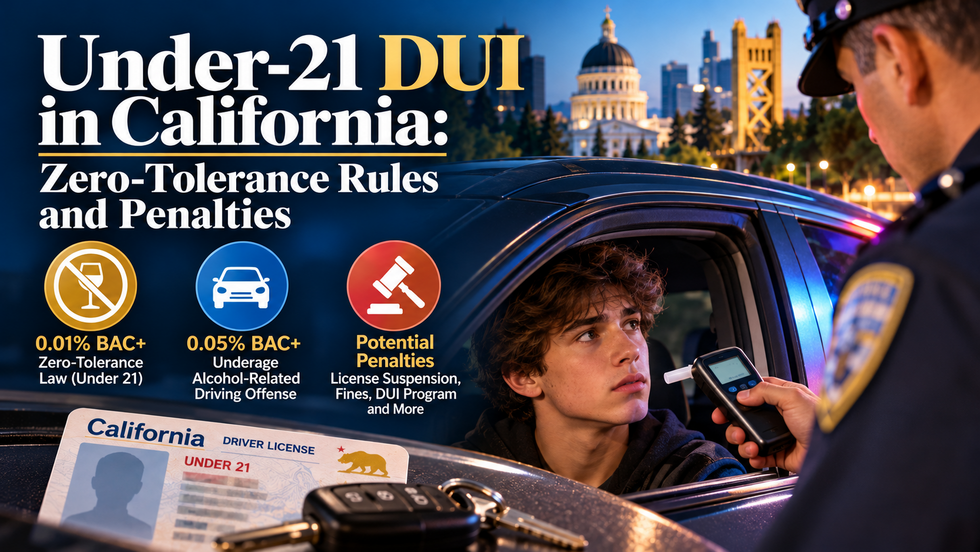
Quick answer: California's under-21 DUI rules
- 0.01% BAC or higher: California's zero-tolerance law can apply to drivers under 21.
- 0.05% BAC or higher: A separate underage alcohol-related driving offense may apply.
- 0.08% BAC or higher: The standard adult per se DUI threshold may also apply, along with other DUI laws.
- License consequences: A qualifying violation can lead to suspension or revocation of driving privileges.
- Refusing a required chemical test: Can trigger separate DMV consequences.
The exact outcome depends on the driver's age, BAC, test results, whether the driver refused testing, prior record, and the facts of the incident. California's rules also distinguish between an administrative DMV action and a criminal court case. The California Driver Handbook's alcohol and drugs section explains the applicable BAC limits and under-21 requirements.
What Is California's Zero-Tolerance DUI Law?
California's zero-tolerance law prohibits drivers under 21 from driving with a BAC of 0.01% or greater under the circumstances covered by the law. The relevant provision is California Vehicle Code Section 23136.
The purpose of this rule is to discourage underage drinking and driving. Unlike the standard adult per se DUI threshold of 0.08%, the zero-tolerance threshold is much lower.
A young driver therefore should not assume that a small amount of alcohol is legally acceptable before driving. Even if the driver does not appear visibly intoxicated, a qualifying alcohol screening result can lead to a zero-tolerance action.
Important: Zero tolerance does not mean that every underage driver automatically receives the same penalty. The applicable statute, test result, evidence, and procedural circumstances determine which consequences may apply.
For the current rule, consult the California DMV Driver Handbook and the applicable provisions of the California Vehicle Code.
What BAC Limits Apply to Drivers Under 21?
California has different alcohol-related driving thresholds. Understanding the differences is important because a driver under 21 may face consequences under more than one provision depending on the evidence.
| BAC Level | Potential Legal Significance |
|---|---|
|
0.01% or higher |
May trigger California's under-21 zero-tolerance law under Vehicle Code Section 23136. |
|
0.05% or higher |
May support a separate under-21 alcohol-related driving offense under Vehicle Code Section 23140. |
|
0.08% or higher |
Meets the standard adult per se BAC threshold and may support a DUI charge under the applicable law. |
These thresholds are not a complete description of every possible DUI charge. A person can also face a DUI charge based on impairment, even when a test result is below 0.08%.
BAC is a measurement of the concentration of alcohol in a person's blood. A person's actual impairment can vary based on multiple factors, and a BAC number alone does not describe every aspect of a DUI investigation.
Penalties for an Under-21 DUI in California
The consequences of an underage alcohol-related driving incident depend on the offense charged and the facts of the case. The zero-tolerance violation, the 0.05% offense, and a standard DUI charge are legally distinct.
1. Zero-Tolerance Violation: BAC of 0.01% or Higher
Vehicle Code Section 23136 addresses drivers under 21 who operate a motor vehicle with a BAC of 0.01% or greater under the conditions specified by the statute.
A qualifying zero-tolerance violation can lead to an administrative license suspension or revocation. California DMV materials explain that a driver under 21 suspended under the zero-tolerance law may have to pay a reissue fee and satisfy the applicable requirements before driving privileges are restored.
The zero-tolerance offense is generally treated as an infraction rather than the same criminal offense as an adult DUI. However, an infraction should not be dismissed as inconsequential: the driving privilege consequences can be significant.
2. Underage Alcohol-Related Driving: BAC of 0.05% or Higher
California Vehicle Code Section 23140 addresses driving by a person under 21 with a BAC of 0.05% or greater.
This provision is separate from the zero-tolerance law. A qualifying violation can lead to an infraction, a required DUI program, and a one-year license suspension under the applicable statutory provisions.
The circumstances may also support a separate DUI charge if the evidence satisfies the requirements of another applicable statute. The court and DMV consequences can therefore extend beyond the penalties associated with the 0.05% offense alone.
3. Standard DUI Charges
A driver under 21 can also face a standard DUI charge when the evidence supports it. California's DUI laws can apply when a person drives under the influence of alcohol or drugs, and a BAC of 0.08% or higher meets the standard adult per se threshold.
A DUI charge can carry consequences beyond an infraction, including potential jail time, fines, probation conditions, DUI education requirements, and license suspension. The specific penalties depend on the charge, prior record, whether an accident occurred, whether anyone was injured, and other circumstances.
For more information about the broader criminal process, read about the DUI court process in Sacramento.
Can an Under-21 Driver Lose a License for One Year?
Yes. A one-year suspension can apply in certain underage alcohol-related driving cases, but the legal basis for the suspension matters.
For example, California's zero-tolerance law can result in suspension or revocation of a qualifying under-21 driver's license. A violation of Vehicle Code Section 23140 involving a BAC of 0.05% or higher also carries a one-year license suspension under the applicable provisions.
Other DUI charges and chemical-test refusals can involve separate suspension periods or additional consequences. The driver should review the DMV notice and any court paperwork rather than assume that every underage DUI case has the same suspension period.
California DMV provides information about license actions and reinstatement in its DUI guidance.
What Happens After an Under-21 DUI Arrest?
An under-21 DUI incident can involve both an administrative DMV process and a court proceeding. These are separate processes, and each may affect the driver's situation.
Depending on the circumstances, the process may include:
- An alcohol screening test or other chemical testing.
- A citation or arrest, depending on the suspected offense and circumstances.
- A notice concerning the driver's license or driving privilege.
- A DMV administrative review or hearing, when applicable.
- A court proceeding for the charged offense.
- Possible DUI education or treatment requirements.
- Steps to satisfy the applicable conditions before driving privileges are restored.
The actual sequence varies by case. An underage driver and their parent or guardian should read all notices carefully and check the deadlines that apply.
Can Police Require an Under-21 Driver to Take an Alcohol Test?
California law permits officers to request or require testing in circumstances governed by the applicable statutes. For drivers under 21, California has special provisions concerning preliminary alcohol screening tests and suspected alcohol consumption.
A preliminary alcohol screening (PAS) test is commonly administered using a handheld breath-testing device. Depending on the circumstances, additional chemical testing may be required or requested under California's implied-consent rules.
The legal significance of a PAS result can differ from that of an evidentiary breath or blood test. The driver's age, whether the driver is on DUI probation, the reason for the stop, and the applicable statute can affect the testing requirements.
Drivers should not assume that all tests are legally identical or that a particular test result automatically resolves every issue in the case.
What Happens if an Under-21 Driver Refuses a Chemical Test?
Refusing a legally required chemical test can result in additional consequences. California DMV explains that a driver who refuses a required test after a DUI investigation may face license suspension or revocation.
The applicable rules depend on the driver's age, whether the driver is subject to an implied-consent requirement, the type of test involved, and the facts of the incident. The consequences of refusing a test can be separate from those associated with the underlying DUI allegation.
If an underage driver receives a DMV notice after a refusal, it is important to review the stated basis for the action and the deadline for requesting a hearing, if one is available.
The 10-Day DMV Hearing Deadline
California DMV states that, for applicable DUI administrative suspension actions, a driver generally has 10 days from the date of arrest to request an administrative hearing. The deadline and procedure should be confirmed against the actual notice received.
A DMV hearing addresses the administrative action affecting the driving privilege. It is separate from the criminal or infraction case in court.
Do not ignore a DMV notice. Missing a deadline can affect the ability to challenge an administrative license action. Review the documents promptly and seek qualified legal advice if you are unsure how the deadline applies.
You can read more about the distinction between the two proceedings in this guide to court and DMV hearings in Sacramento.
Can an Under-21 Driver Be Charged With DUI Below 0.08% BAC?
Yes. The 0.08% BAC threshold is not a universal minimum below which a person cannot be charged with DUI.
California's under-21 laws include lower alcohol-related thresholds, and a driver can also face a DUI charge if the evidence establishes impairment under the applicable law.
A driver may therefore face legal consequences at a BAC below 0.08%, including a zero-tolerance action, a 0.05% underage offense, or a standard DUI charge when supported by the evidence.
The type of charge and potential penalties should be determined from the actual facts and applicable statutes, not from the BAC number alone.
Can an Under-21 Driver Face DUI Consequences Without a DUI Conviction?
Yes. A DMV administrative action is separate from the criminal court process. A qualifying zero-tolerance violation can affect driving privileges even though it is treated differently from a standard criminal DUI charge.
This distinction is important because the outcome of a court case does not automatically resolve every administrative license issue. Likewise, resolving an administrative DMV action does not necessarily end a court proceeding.
Drivers and families should identify which agency issued each notice and what action it describes.
Can Underage Alcohol Possession in a Vehicle Affect Driving Privileges?
California has separate rules governing alcohol possession by people under 21. These rules are distinct from the laws prohibiting driving with alcohol in the bloodstream.
The California Driver Handbook explains that under-21 drivers generally cannot carry alcoholic beverages in a vehicle unless a statutory exception applies. Where an exception permits transportation, the container must meet the applicable conditions, including being full, sealed, and unopened or being stored as the law requires.
Certain alcohol-related offenses can result in license suspension or delay of driving privileges, even if they do not involve a conventional DUI conviction. The specific result depends on the offense and applicable law.
Because possession rules have exceptions, the details of the situation matter. Consult the current California Driver Handbook for the relevant requirements.
Can an Under-21 DUI Affect Car Insurance?
An alcohol-related driving violation or DUI conviction can affect insurance costs and eligibility. The exact consequences depend on the driver's record, the insurer's approved rating plan, the type of violation, and the policy terms.
A driver who loses eligibility for certain discounts or is considered a higher risk by an insurer may face a higher premium. However, there is no single insurance increase that applies to every young driver after an underage DUI.
Parents who insure a young driver should review the policy and ask the insurer how a new driving-record entry may affect coverage, discounts, and renewal. They should not assume that a license suspension automatically cancels the insurance policy or that every insurer handles the matter identically.
For related information, see how a Sacramento DUI conviction can affect employment, insurance, and driving privileges.
What Should Parents Do After an Underage DUI Incident?
Parents and guardians can help a young driver understand the documents, deadlines, and responsibilities that follow an alcohol-related driving incident.
- Read the citation, arrest paperwork, and DMV notice carefully.
- Identify whether the allegation involves zero tolerance, a 0.05% offense, a standard DUI charge, or another violation.
- Record any hearing or court deadlines.
- Confirm the driver's current license status before allowing them to drive.
- Determine whether a DUI education program or other requirement applies.
- Review insurance arrangements and ask the insurer about policy implications.
- Seek advice from a qualified California attorney if the consequences or allegations are unclear.
A young driver's case should be evaluated based on the specific statute and facts involved. A general description of zero tolerance cannot replace reviewing the actual citation, DMV action, or court paperwork.
Under-21 DUI in California: Frequently Asked Questions
What is the legal BAC limit for drivers under 21 in California?
California's zero-tolerance law applies at a BAC of 0.01% or greater under the conditions specified by Vehicle Code Section 23136. Separate provisions address underage driving at 0.05% BAC or higher, and standard DUI laws may also apply.
Can a driver under 21 get a DUI at 0.02% BAC?
A BAC of 0.02% is above California's 0.01% zero-tolerance threshold. The exact consequences depend on the applicable statute and circumstances, but the driver should not assume that a BAC below 0.05% is legally acceptable.
Is underage DUI always a criminal offense?
No. California's zero-tolerance violation is generally an infraction. A 0.05% underage offense is also generally treated as an infraction, while a separate standard DUI charge can carry criminal penalties. The actual charge matters.
Can a first underage DUI result in a one-year license suspension?
Yes. A one-year suspension can apply to certain qualifying under-21 alcohol-related driving offenses. The specific suspension depends on the legal basis for the DMV or court action.
Can an under-21 driver be charged with DUI below 0.08% BAC?
Yes. The zero-tolerance and 0.05% underage provisions use lower thresholds, and a standard DUI charge may also be based on evidence of impairment under the applicable law.
What happens if an underage driver refuses a chemical test?
A refusal can result in separate DMV consequences when the applicable testing and implied-consent requirements are met. The driver's age, the type of test, and the facts of the incident affect the rules that apply.
Can parents be responsible for an underage driver's DUI?
Parents are not automatically criminally responsible simply because their child is accused of DUI. Separate issues can arise depending on who owns the vehicle, who permitted its use, the insurance arrangement, and other facts. Those questions require individual legal analysis.
Does a zero-tolerance violation stay on the driver's record?
The effect on a driving record depends on the specific violation and DMV action. California DMV states that DUI convictions remain on the driving record for 10 years. Drivers should confirm the record consequences of their particular underage offense with the DMV.
Should a young driver request a DMV hearing?
Whether a hearing is available and appropriate depends on the specific DMV action. If the driver receives a notice of suspension or revocation, they should promptly review the deadline and obtain legal guidance if needed.
Final Takeaway
California's under-21 DUI laws impose stricter alcohol-related driving rules than those that apply to most adult drivers. The zero-tolerance provision can apply at a BAC of 0.01% or greater, while a separate offense can apply at 0.05% or higher. Standard DUI laws may also apply when the evidence supports them.
Potential consequences include a license suspension, an alcohol education program, fines, insurance effects, and—in cases involving a standard DUI charge—additional criminal penalties. A chemical-test refusal or other alcohol-related offense may create separate consequences.
Anyone dealing with an underage DUI allegation should identify the exact offense, review the DMV paperwork, check all deadlines, and confirm the current status of the driving privilege before driving again.
Legal Information Disclaimer: This article is provided by the Law Office of John Campanella for general informational and educational purposes and is not legal advice. California DUI laws, DMV procedures, and penalties can change. The outcome of an under-21 DUI matter depends on the facts, the driver's age, the applicable statute, and the evidence. Consult a qualified California attorney for advice about a specific situation and verify current license requirements directly with the California DMV.

Comments
There are no comments for this post. Be the first and Add your Comment below.
Leave a Comment