
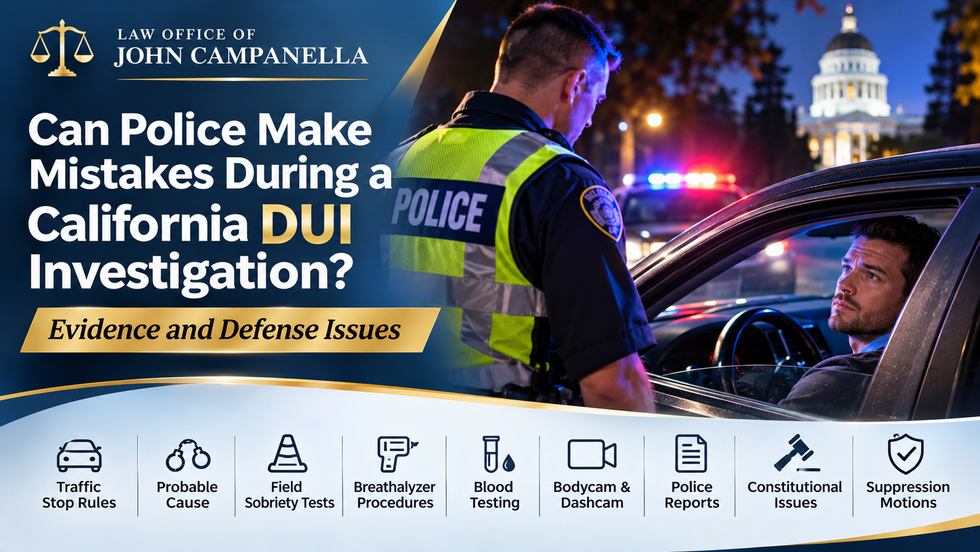
A California DUI investigation can involve several separate decisions: why an officer stopped a vehicle, what the officer observed, whether there was a legal basis for an arrest, how sobriety tests were conducted, and whether breath or blood evidence was collected properly.
Not every mistake made during a DUI investigation automatically leads to a dismissed charge. Some errors may affect the reliability or weight of evidence. Others may raise constitutional or statutory issues that a defense attorney can challenge in court.
As a DUI defense attorney, I look at the investigation as a sequence of events rather than treating the arrest report or chemical-test result as the complete story. The details matter. What did the officer know at each stage? What facts supported the decisions made? Were the tests administered and documented correctly? Does the available video match the written report?
1. California DUI Police Procedure: Why the Initial Traffic Stop Matters
A DUI investigation often begins with a traffic stop. An officer may report seeing a vehicle weave, cross a lane line, speed, fail to stop at a sign, or commit another traffic violation. In other situations, the officer may respond to a collision, a roadside report, or a call about a potentially impaired driver.
The legal basis for the stop is important because an officer generally cannot detain a driver merely because the officer has a hunch that the person may be intoxicated.
Reasonable suspicion for a traffic stop
A temporary investigative detention generally requires reasonable suspicion supported by specific, articulable facts. The officer must be able to identify circumstances that reasonably suggest criminal activity or a traffic violation and connect those circumstances to the person being detained.
For example, an officer may describe:
-
A vehicle repeatedly crossing lane markings.
-
Driving at an unusually slow or inconsistent speed under the circumstances.
-
An apparent traffic violation.
-
A collision or other driving conduct that requires investigation.
-
A reliable report describing potentially unlawful driving.
A driver's nervousness, standing alone, does not automatically establish reasonable suspicion of DUI. Nor does an officer's unexplained belief that someone appears suspicious necessarily justify a detention.
The circumstances must be evaluated together. A driving pattern that has an innocent explanation may still justify a brief investigation if the facts reasonably support suspicion. The question is whether the officer had an objectively reasonable basis for the stop at the time it occurred.
What if the officer gives an incorrect reason for the stop?
The reason written in a police report should be compared with the available evidence. Dashcam footage, bodycam recordings, dispatch records, witness statements, and photographs may help establish what actually happened.
An inconsistency does not automatically invalidate a stop. However, if the evidence shows that the officer lacked a legally sufficient basis for the detention, a defense attorney may examine whether evidence obtained as a result of the unlawful stop should be excluded.
2. Probable Cause for a California DUI Arrest
A lawful traffic stop does not automatically give an officer authority to arrest the driver for DUI. The investigation must develop enough facts to establish probable cause.
Probable cause is a practical legal standard. It generally exists when the facts known to the officer would lead a reasonable person to believe that the individual committed an offense. It does not require proof beyond a reasonable doubt, which is the standard used at a criminal trial.
Evidence officers may consider
During a DUI investigation, an officer may document observations such as:
-
The odor of an alcoholic beverage.
-
Slurred or unusually slow speech.
-
Bloodshot or watery eyes.
-
Difficulty maintaining balance.
-
An admission to consuming alcohol or using drugs.
-
Driving conduct that may indicate impairment.
-
Performance on field sobriety tests.
-
Preliminary alcohol screening results.
-
Other statements or physical observations.
No single observation necessarily proves DUI. For example, the odor of alcohol may indicate consumption, but it does not by itself establish that a person's ability to drive was impaired. Similarly, bloodshot eyes or nervous behavior can have explanations unrelated to intoxication.
The complete circumstances must be considered.
Can an arrest be challenged if the officer relied on weak evidence?
Potentially. A defense review may examine whether the officer's observations were accurate, whether important facts were omitted, and whether the total circumstances supported probable cause at the time of arrest.
The timing is important. Evidence obtained after an arrest generally cannot retroactively create probable cause that did not exist when the arrest occurred. However, information discovered during a lawful investigation before the arrest may contribute to the probable-cause analysis.
3. Field Sobriety Tests: Administration and Interpretation
Field sobriety tests are commonly used to assess a driver's coordination, balance, attention, and ability to follow instructions. They may become part of the evidence supporting an officer's decision to arrest someone for DUI.
Common standardized field sobriety tests include:
Horizontal Gaze Nystagmus (HGN)
The officer observes the movement of the driver's eyes while following a stimulus, such as a pen or small object. The officer looks for specified indicators associated with impairment.
The test requires proper administration and interpretation. Medical conditions, certain medications, eye-related issues, environmental conditions, and other factors may affect observations.
Walk-and-Turn
The driver is instructed to take a series of steps along a straight line, turn in a specified manner, and walk back.
The officer may record whether the driver follows instructions, maintains balance, takes the correct number of steps, and performs the turn as directed.
One-Leg Stand
The driver is asked to stand on one leg while counting for a specified period.
Balance problems, physical limitations, injuries, footwear, age, fatigue, and the surface on which the test is performed may affect performance.
Questions to examine about field sobriety testing
When reviewing field sobriety evidence, I would want to know:
-
Were the instructions complete and understandable?
-
Did the officer demonstrate the test correctly?
-
Was the surface reasonably level and suitable?
-
Were lighting and weather conditions appropriate?
-
Was the driver wearing footwear that affected balance?
-
Did an injury, disability, or physical limitation affect performance?
-
Did the officer document the test accurately?
-
Does the video show the same performance described in the report?
Field sobriety tests are not infallible measurements of blood alcohol concentration. They are observations that may be considered with other evidence. A person can perform poorly for reasons unrelated to alcohol or drug impairment.
A defense attorney should examine both the officer's training and the actual conditions under which the tests were administered.
4. Preliminary Alcohol Screening Devices and Breathalyzer Procedures
Breath testing can occur at more than one stage of a California DUI investigation. It is important to distinguish a preliminary alcohol screening test from a post-arrest evidentiary chemical test.
Preliminary Alcohol Screening (PAS)
A PAS device is commonly used during a roadside investigation to estimate alcohol concentration in a person's breath. For many adult drivers, the PAS test is generally a field investigation tool rather than the same test used to establish the evidentiary chemical-test result after arrest.
California law has specific rules concerning PAS testing, including advisements in applicable circumstances. Different rules may apply to drivers under 21, drivers on DUI probation, and other categories covered by law.
A driver should not assume that every roadside breath test has the same legal status or consequences as a post-arrest chemical test.
Post-arrest evidentiary breath testing
After a lawful DUI arrest, California's implied-consent law generally requires the driver to submit to an appropriate chemical test. For an alcohol-related DUI arrest, the driver is generally given a choice between a breath test and a blood test, subject to statutory exceptions and circumstances affecting the availability or suitability of a test.
Breath-testing evidence may require examination of:
-
The device used and its approval or applicable certification.
-
Maintenance and accuracy-check records.
-
Operator training and qualifications.
-
Testing procedures and documentation.
-
Whether the required observation period was followed.
-
Whether the driver provided adequate samples.
-
Whether the results were consistent.
-
Whether the instrument reported an error or irregularity.
A breath result is evidence, not an automatic answer to every issue in a DUI case. The meaning of the result depends on the circumstances, the testing process, and the legal issues involved.
Why the observation period may matter
California regulations and applicable testing procedures address observation before evidentiary breath testing. The purpose is to help identify circumstances that could affect the sample, including certain mouth-alcohol or other interference concerns.
The exact requirements depend on the governing regulations and testing method. A defense review should examine the applicable standard, the operator's records, and whether the evidence establishes compliance. It should not assume that every procedural discrepancy automatically makes the result inadmissible.
5. Blood Sample Collection: Consent, Warrants, and Testing Issues
Blood testing may be used in California DUI cases involving alcohol, drugs, or a combination of substances. Because a blood draw involves a physical intrusion, constitutional rules and statutory procedures matter.
California's implied-consent law
Vehicle Code section 23612 addresses chemical testing following a lawful DUI arrest. For an alcohol-related arrest, the law generally provides a choice between blood and breath testing. Different provisions apply when an officer reasonably suspects drug impairment or when a particular test is unavailable or cannot be completed.
The law also contains advisement requirements and consequences associated with refusing or failing to complete a required chemical test.
Implied consent does not mean that every possible blood draw is automatically constitutional. The circumstances surrounding the collection still matter.
When a warrant may be required
The Fourth Amendment generally requires law enforcement to obtain a warrant before conducting a nonconsensual blood draw unless a recognized exception applies.
In Missouri v. McNeely (2013), the United States Supreme Court explained that the natural dissipation of alcohol in the bloodstream does not, by itself, create an automatic emergency that excuses obtaining a warrant in every DUI case. Whether an exception applies depends on the circumstances.
A warrantless blood draw may be challenged if the legal requirements for an exception were not satisfied. A warrant-based blood draw may also raise issues if the warrant or its execution was legally defective.
Blood collection and laboratory issues
A defense review may examine:
-
Whether the blood draw was supported by valid consent, a warrant, or another lawful basis.
-
Whether the person who collected the sample was legally qualified to do so.
-
Whether the collection method was appropriate.
-
Whether the sample was properly identified and labeled.
-
Whether collection and transfer records are complete.
-
Whether storage and handling procedures were followed.
-
Whether the laboratory's testing methods and records are reliable.
-
Whether the reported result can be connected to the correct sample.
A possible chain-of-custody gap does not automatically invalidate a blood result. The significance depends on the nature of the discrepancy and whether the prosecution can establish that the sample tested was the sample collected from the defendant and that the result is reliable.
6. Bodycam and Dashcam Evidence Can Tell a Different Story
Police reports are important, but they are not the only record of a DUI investigation. Body-worn cameras and patrol-car dashcams may capture events that are not fully described in a written report.
Video may help establish:
-
The driving conduct observed before the stop.
-
The officer's explanation for the detention.
-
The driver's physical appearance and speech.
-
The instructions given before field sobriety tests.
-
The conditions where testing occurred.
-
The driver's actual performance.
-
Statements made by the driver or officer.
-
The timing of the arrest and chemical testing.
Why video may matter
For example, an officer may report that a driver repeatedly lost balance during a field sobriety test. A video recording may show the driver completing most of the test but struggling with one instruction. That difference may be relevant when evaluating the accuracy and completeness of the report.
Video evidence can also support the officer's account. A careful defense review should not assume that recordings will always help the driver.
What if the video is missing?
A missing recording does not automatically require dismissal of a DUI charge. The legal consequences depend on whether a recording was made, whether it was required by policy or law, whether it was preserved, whether it was potentially exculpatory, and what happened to it.
A defense attorney may request available recordings and related records through the appropriate discovery process. If relevant evidence was lost or destroyed, the circumstances should be examined before deciding whether a legal remedy is available.
7. Police Reports: Comparing Written Statements With Other Evidence
A police report usually summarizes the officer's observations, statements, testing, and reasons for taking enforcement action. It may also identify witnesses, other officers, chemical-test information, and evidence collected.
A report is not necessarily a complete recording of everything that happened.
When reviewing a report, I look for issues such as:
-
Whether the stated reason for the stop is supported by the evidence.
-
Whether the timeline is consistent.
-
Whether the officer distinguishes personal observations from information received from another person.
-
Whether statements are accurately attributed.
-
Whether field sobriety instructions and results are described in sufficient detail.
-
Whether the report identifies the devices and procedures used.
-
Whether relevant facts appear to be missing or inconsistent.
-
Whether supplemental reports change or clarify the original account.
Inconsistencies are not all equally important
A minor difference in wording may have little legal significance. A major inconsistency about who was driving, when the vehicle was stopped, what the officer observed before the arrest, or how a chemical sample was obtained may deserve closer attention.
The goal is not simply to find a difference between documents. It is to determine whether the difference affects a material issue in the case.
8. Constitutional Issues in a California DUI Investigation
Several constitutional protections may apply during a DUI investigation. The most relevant issues often involve the Fourth Amendment, which protects against unreasonable searches and seizures, and the Fifth Amendment privilege against compelled testimonial self-incrimination.
Fourth Amendment: Stops, arrests, and searches
The Fourth Amendment may become relevant when:
-
An officer stops a vehicle without reasonable suspicion.
-
A detention continues longer than legally justified.
-
An arrest occurs without probable cause.
-
Officers search a vehicle or obtain evidence without a warrant or valid exception.
-
A blood sample is taken without a lawful basis.
The legality of each action depends on the facts and applicable exceptions. A lawful initial stop does not automatically make every later detention, arrest, search, or evidence collection lawful.
Fifth Amendment: Statements and questioning
The Fifth Amendment protects against compelled testimonial self-incrimination. Miranda warnings are generally required before custodial interrogation, subject to recognized exceptions.
However, not every question asked during a DUI investigation requires Miranda warnings. A roadside detention does not automatically amount to custody for Miranda purposes. Physical observations and certain non-testimonial evidence are also treated differently from compelled testimonial statements.
A defense attorney should identify when the person was in custody, what questions were asked, whether the questioning was likely to elicit incriminating responses, and whether the statements were voluntary.
9. Suppression Motions: Can Improperly Obtained DUI Evidence Be Excluded?
A suppression motion asks the court to exclude evidence obtained through an unlawful search or seizure or another legally recognized violation.
In California, Penal Code section 1538.5 provides a procedure for challenging certain searches and seizures. The appropriate motion, legal basis, timing, and remedy depend on the circumstances of the case.
Examples of issues that may support a suppression challenge
A defense attorney may consider a suppression motion when the evidence suggests:
-
An unlawful traffic stop: The officer lacked reasonable suspicion to detain the driver.
-
An unlawful detention: The investigation was extended beyond what the circumstances legally justified.
-
An arrest without probable cause: The facts known to the officer did not support the arrest.
-
An unlawful search: Officers searched a person or vehicle without a valid warrant, consent, or applicable exception.
-
An unconstitutional blood draw: A blood sample was obtained without valid consent, a warrant, or a recognized exception.
-
An improper seizure of evidence: Evidence was obtained in violation of a protected constitutional right.
What happens if a suppression motion is granted?
The result depends on which evidence is excluded and whether the prosecution can still prove its case with the remaining admissible evidence.
For example, excluding a particular chemical-test result does not necessarily mean that all other evidence is excluded. The prosecution may still have officer observations, witness testimony, driving evidence, or other admissible proof.
Conversely, if excluded evidence is essential to the prosecution's case, the ruling may significantly affect the case's viability.
A suppression motion is not a guaranteed strategy. It requires a legal basis supported by the facts and evidence.
10. How I Evaluate Possible Police Errors in a DUI Case
I do not treat every difference in a police report as proof that the investigation was unlawful. The important question is whether an error affects a legal element, the reliability of evidence, the credibility of a witness, or the admissibility of evidence.
A thorough review may involve several steps.
Step 1: Reconstruct the timeline
I compare the reported driving conduct, traffic stop, questioning, field sobriety tests, arrest, and chemical testing. Timing can be particularly important when the prosecution relies on a chemical result obtained after driving.
Step 2: Review recordings
Bodycam and dashcam footage may help confirm or contradict the written report. Dispatch audio, nearby surveillance footage, and witness recordings may also be relevant when available.
Step 3: Examine the basis for the stop and arrest
I consider what the officer knew before the detention and before the arrest. These are separate legal questions, and the evidence must be evaluated at the appropriate point in the timeline.
Step 4: Review field sobriety and chemical testing
I examine the instructions, testing conditions, device records, sample collection, laboratory documentation, and any applicable procedural requirements.
Step 5: Compare reports and supporting records
I look for material inconsistencies between the original report, supplemental reports, recordings, witness statements, and testing records.
Step 6: Identify legal remedies
Depending on the evidence, possible issues may include a suppression motion, challenges to the reliability or interpretation of test results, evidentiary objections, or arguments about the weight of the prosecution's evidence.
Not every case calls for every type of challenge. The defense strategy should be based on the actual record.
11. What Should You Do After a California DUI Arrest?
If you have been arrested for DUI in California, preserving information and paying attention to deadlines can be important.
Consider taking these steps:
-
Keep copies of citations, release paperwork, and any documents provided by law enforcement.
-
Write down your recollection of the stop, questioning, tests, arrest, and chemical testing while the events are still fresh.
-
Preserve photographs, videos, messages, receipts, and other records that may establish timing or location.
-
Identify potential witnesses and preserve their contact information.
-
Do not delete or alter potentially relevant material.
-
Avoid discussing the facts of the case publicly or posting about the incident on social media.
-
Speak with a California DUI defense attorney about the criminal case and any DMV action.
Remember the DMV deadline
A DUI arrest may trigger a separate administrative license proceeding through the California Department of Motor Vehicles. In many cases involving an administrative suspension or revocation, a driver has only 10 days from receipt of the suspension or revocation notice to request a DMV hearing.
The actual notice and circumstances should be reviewed promptly. The DMV proceeding is separate from the criminal court case, and a favorable result in one does not automatically determine the other.
12. Frequently Asked Questions About California DUI Police Procedure
Can police stop a driver just because they suspect DUI?
An officer generally needs reasonable suspicion supported by specific facts to make an investigative traffic stop or detention. A mere hunch is not enough. The facts and circumstances known to the officer at the time are important.
Can a DUI arrest be challenged if the officer made a mistake?
Yes, depending on the nature of the mistake. Some errors may affect the credibility or weight of evidence. Others may raise constitutional or statutory issues that could support a motion to exclude evidence. A mistake does not automatically require dismissal.
Do police have to perform field sobriety tests before making a DUI arrest?
No. Field sobriety tests are commonly used, but they are not an absolute prerequisite to every DUI arrest. Probable cause may be established through other facts and observations.
Can I challenge field sobriety test results?
Potentially. Relevant issues may include the instructions, testing surface, weather, footwear, injuries, physical limitations, officer training, and whether the test was properly administered and documented.
Is a roadside PAS breath test the same as a post-arrest breath test?
No. A PAS test is generally a preliminary investigative tool. A post-arrest evidentiary chemical test serves a different purpose and is governed by different legal and procedural requirements.
Can a California DUI blood test be challenged?
Yes. Depending on the circumstances, a defense attorney may examine the legal basis for the draw, consent or warrant issues, collection procedures, sample identification, chain of custody, laboratory methods, and testing records.
Does a missing bodycam video mean the DUI case will be dismissed?
Not automatically. The consequences depend on whether the recording existed, whether it should have been preserved, why it is missing, whether it was potentially exculpatory, and what legal remedy is available.
Can a police report contain mistakes and still be used in court?
Yes. A report may contain errors and still be considered as part of the case. The importance of an error depends on what it concerns, whether it can be corrected or explained, and whether it affects admissibility, credibility, or the strength of the evidence.
What is a California DUI suppression motion?
A suppression motion is a legal request to exclude evidence obtained through an unlawful search or seizure or another legally recognized violation. Penal Code section 1538.5 is an important California procedure for challenging certain searches and seizures.
If a judge suppresses the breath or blood result, will the DUI charge be dismissed?
Not necessarily. The prosecution may still rely on other admissible evidence. The effect of a suppression ruling depends on what evidence is excluded and what remains.
Should I request a DMV hearing after a DUI arrest?
If your license is subject to an administrative suspension or revocation, you should review the notice and act quickly. The usual deadline to request a hearing in many APS cases is 10 days from receipt of the notice. Missing the deadline can limit your ability to challenge the administrative action.
Conclusion:
A California DUI investigation involves more than a traffic stop and a breath or blood test. The legality of the detention, the facts supporting the arrest, the administration of field sobriety tests, the collection of chemical evidence, and the accuracy of police reports can all matter.
An officer's mistake does not automatically invalidate a DUI case. But when a mistake affects a constitutional right, a statutory requirement, the reliability of evidence, or the credibility of the investigation, it deserves careful legal analysis.
I encourage anyone facing a California DUI charge to have the available reports, recordings, testing records, and DMV paperwork reviewed promptly. The right approach depends on the facts of the individual case, not on assumptions about what an officer did or did not do.
If you are facing a DUI charge in Sacramento or elsewhere in California, you can learn more about the Law Office of John Campanella at SacramentoDUIInformation.com or contact me to discuss your situation.
Legal disclaimer: This article is for general informational and educational purposes only. It is not legal advice and does not create an attorney-client relationship. California DUI laws and procedures may change, and the application of the law depends on the specific facts of each case. Consult a qualified California attorney about your circumstances.

Comments
There are no comments for this post. Be the first and Add your Comment below.
Leave a Comment