
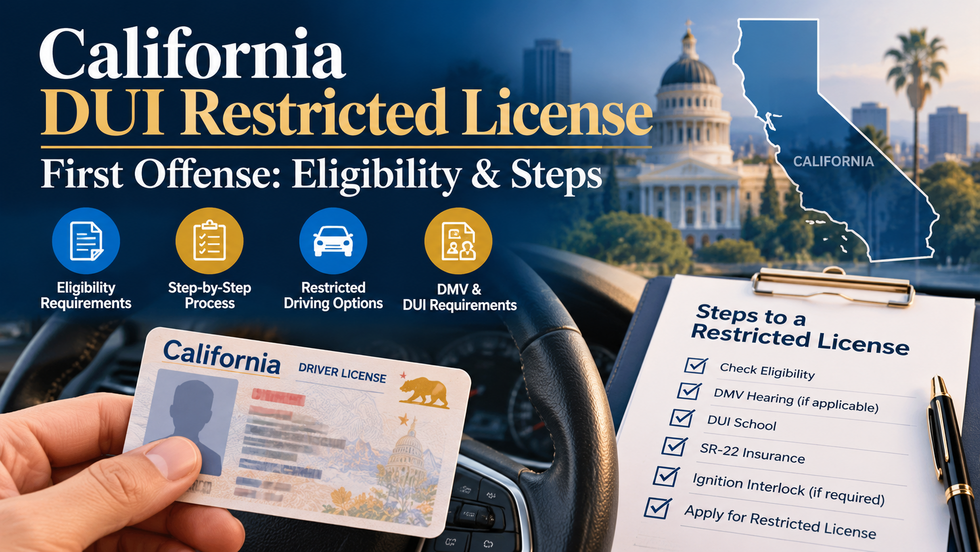
A first DUI in California can affect your driver's license before your criminal case is finished. For many drivers, the most immediate concern is whether they will still be able to drive to work, attend required DUI classes, and handle necessary daily responsibilities.
In certain first-offense DUI cases, California provides restricted-license options that may allow a person to continue driving under specific conditions. Depending on the circumstances, an eligible driver may be able to obtain an employment/treatment-program restriction or an ignition interlock device (IID) restriction. The requirements are not identical in every case.
Quick answer:
A first DUI does not automatically mean that you must remain completely unable to drive for the entire suspension period. Depending on your DMV action, DUI conviction, chemical-test history, age, injury status, prior record, and court orders, you may qualify for a restricted license or IID-restricted driving privilege after completing the required steps.
California DMV states that a restricted-license request is separate from a DMV administrative hearing. A driver does not need to request a restricted license during the hearing itself. The DMV provides separate procedures for applying for an IID or other restricted driving privilege. Law Office of John Campanella provides the current requirements and restriction options.
First DUI Restricted License in California: At a Glance
| Question | General Answer |
|---|---|
|
Can a first offender get a restricted license? |
In qualifying cases, yes. |
|
Is it automatic? |
No. DMV requirements must be satisfied. |
|
Is DUI school required? |
It is required for applicable DUI restriction and reinstatement procedures. |
|
Is SR-22 required? |
California DMV generally requires proof of financial responsibility for DUI-related reinstatement and restriction procedures. |
|
Is an IID always required? |
No. The requirement depends on the circumstances and any applicable court or DMV restriction. |
|
Can I drive to work? |
An employment/treatment-program restriction can permit qualifying work-related driving. |
These are general rules. The exact restriction available to an individual driver depends on the specific DMV action, court order, driving history, and facts of the DUI case.
What Is a Restricted Driver's License?
A restricted driver's license is different from a normal unrestricted California driver's license. It allows driving only under conditions established by the applicable restriction.
For some first offenders, an employment/treatment-program restriction can allow driving to, from, and during employment and to and from the required DUI program. An IID restriction can allow broader driving while requiring the vehicle being operated to have a qualifying ignition interlock device.
The distinction matters because a person cannot simply assume that receiving a restricted license gives them unrestricted driving privileges.
For broader background, read how a DUI can affect your driver's license in California.
Can You Get a Restricted License After a First DUI?
In qualifying first-offense DUI cases, California provides restricted-license options. However, "first DUI" by itself does not answer the eligibility question.
The following factors can affect which rules apply:
- Whether the DUI involved alcohol, drugs, or both.
- Whether the driver was 21 or older.
- Whether a required chemical test was completed or refused.
- Whether anyone was injured.
- Whether the court ordered an ignition interlock device.
- Whether the driver has other outstanding suspensions or revocations.
- Whether the required DUI program has been started or completed.
- Whether the required proof of financial responsibility has been filed.
For example, California DMV identifies separate restriction options for first offenders, injury cases, repeat offenders, and drug-only offenses. That is why an article describing a single "first DUI rule" cannot accurately cover every driver's situation.
The Two Main First-Offense Restriction Options
1. Employment/Treatment-Program Restriction
One option available to qualifying first offenders is a restriction that limits driving to employment-related purposes and transportation to and from the required DUI program.
California DMV's current IID program information states that, in the absence of a court-ordered IID, certain first-time alcohol-related offenders may choose an employment/treatment-program restriction. The restriction can allow driving to, from, and during employment and to and from the DUI program for the applicable period.
2. Ignition Interlock Device Restriction
An ignition interlock device is installed in a vehicle and requires the driver to provide a breath sample before the vehicle can start. A qualifying IID-restricted license can provide broader driving authority than an employment-only restriction, but the driver must comply with the IID requirement.
California's statewide IID program has been extended through January 1, 2033. Under the current program, qualifying first-time alcohol-related offenders may have an IID option, while the exact restriction period depends on the applicable circumstances.
Important distinction
An IID restriction and an employment/treatment-program restriction are not the same thing. An IID restriction generally requires the vehicle to be equipped with the device, while an employment/treatment restriction limits driving to the purposes specified by the restriction.
Step 1: Review the DMV Paperwork You Received
After a DUI arrest, carefully review the documents provided by the arresting officer. The paperwork can identify the DMV action, temporary driving status, and applicable deadlines.
For drivers 21 and older who take a qualifying chemical test showing a BAC of 0.08% or higher, California DMV states that a first offense results in a four-month administrative suspension. Different rules can apply to drivers under 21, chemical-test refusals, drug-related cases, injury cases, and drivers with prior qualifying offenses.
The first step is therefore not simply "apply for a restricted license." It is to determine exactly what DMV action applies to you.
Step 2: Understand the 10-Day DMV Hearing Deadline
If you receive an Order of Suspension and Temporary License after a qualifying DUI arrest, California DMV generally gives you 10 days to request an administrative hearing.
The hearing gives you an opportunity to challenge the administrative suspension. California DMV specifically explains that requesting a restricted license is not the same thing as requesting a DMV hearing.
Do not wait until the suspension begins to investigate the hearing deadline. If you have recently been arrested for DUI, check the date on your DMV paperwork immediately. The Sacramento DUI information site also explains the distinction between the DMV hearing process and the criminal DUI case.
Step 3: Determine Whether the DMV or Court Has Imposed an IID Requirement
Do not assume that the DMV and court impose identical requirements.
A court can order installation of an ignition interlock device as part of a DUI case. When a court orders an IID, the driver must comply with the court's requirements in addition to satisfying applicable DMV requirements.
California DMV explains that if the court orders an IID, the driver must have it installed by an authorized installer and provide the required proof of installation.
If you want to understand the broader criminal side of a Sacramento DUI case, see the DUI court process in Sacramento.
Step 4: Enroll in the Required DUI Program
A DUI education program is an important part of California's license reinstatement and restriction process.
California DMV states that a person convicted of DUI must complete a DUI program, file the required proof of financial responsibility, and pay applicable reissue or restriction fees.
The program length is not necessarily identical in every case. It can depend on the offense and other circumstances.
Keep your enrollment documentation. DMV may require proof of enrollment when you apply for a restricted license.
Step 5: Obtain an SR-22 Filing
California uses an SR-22, also called a California Insurance Proof Certificate, as proof of financial responsibility for certain DUI-related license actions.
The SR-22 is filed with the DMV by an insurance company. It is not itself a separate automobile insurance policy.
California DMV states that proof of insurance must remain on file for the required period following certain suspensions and restrictions.
Do not assume that obtaining an insurance policy automatically completes the DMV requirement. The required filing must be properly submitted to the DMV.
Step 6: Install the IID if Your Restriction Requires One
If you select or are subject to an IID restriction, the device must be installed according to California's requirements.
After installation, California DMV identifies a Verification of Installation Ignition Interlock form, DL 920, as documentation that can be required when applying for the IID-restricted license.
The device also has continuing maintenance and compliance requirements. Missing required service, calibration, or other IID obligations can create additional problems.
For more information, read how an ignition interlock device works.
Step 7: Clear Other Suspensions or Revocations
A restricted DUI license does not necessarily override other problems on your driving record.
California DMV's IID program states that applicants must clear all other outstanding suspensions or revocations before obtaining an IID-restricted driver license.
This means that someone dealing with multiple DMV actions may have additional requirements beyond the DUI-related restriction.
Step 8: Pay the Applicable DMV Fees
The DMV may require reissue, restriction, administrative service, or other applicable fees depending on the type of restriction and license action.
The exact amount can vary by the type of DMV action. For example, California DMV currently identifies a $125 administrative service fee for certain first-offender APS restrictions, while other restriction procedures can involve different fee combinations.
Check the current DMV requirements for your particular action before paying or submitting an application.
Step 9: Apply for the Restricted License
Once the applicable requirements have been satisfied, the driver can apply through the DMV.
Depending on the type of restriction, documentation can include:
- Proof of enrollment in the required DUI program.
- California Insurance Proof Certificate (SR-22).
- Proof of IID installation when an IID restriction applies.
- Payment of applicable fees.
- Evidence that other suspensions or revocations have been cleared.
California DMV recommends visiting a DMV office for these transactions and recommends making an appointment.
How Long Does a First-DUI Restricted License Last?
There is no single restriction period that applies to every first DUI.
For qualifying first-time alcohol-related offenders, California DMV currently describes an employment/treatment-program restriction of up to one year in circumstances where the court did not order an IID. The same DMV information identifies an IID option with a different applicable period.
The administrative-per-se process can have different periods. California DMV states that an eligible first-time non-refusal APS offender may apply for an IID restriction of up to four months, while an employment/treatment-program restriction can become available after serving the applicable initial portion of the suspension.
Therefore, the correct answer depends on whether you are dealing with the administrative suspension, the post-conviction restriction, or both.
Can You Drive to Work With a Restricted License?
A qualifying employment/treatment-program restriction can permit driving to, from, and during employment and to and from the required DUI program.
That does not necessarily mean you can use the vehicle for every personal trip.
For example, a driver should not assume that a work-and-treatment restriction automatically authorizes unrestricted recreational driving, long-distance personal trips, or any other activity not covered by the restriction.
If maintaining employment is your primary concern after an arrest, see Can I drive to work after a DUI arrest in Sacramento County?
Can You Drive Anywhere With an IID Restriction?
An IID restriction can provide broader driving authority than an employment/treatment-program restriction, but the vehicle must comply with the IID requirement.
California DMV's first-offender materials describe an IID-restricted license as allowing driving at any time and to any place while operating a vehicle equipped with the required IID, subject to the applicable restriction and reinstatement requirements.
Drivers should also understand that court orders can impose additional requirements.
What Can Make a First DUI More Complicated?
The following circumstances can change the license consequences or the available restriction:
- Chemical-test refusal: A qualifying first refusal can result in a one-year DMV suspension for many drivers age 21 or older.
- Injury: DUI cases involving injury can have different restriction and suspension rules.
- Drug-only DUI: California has separate rules for drug-only DUI cases.
- Prior DUI history: A driver's previous record can change the applicable DMV consequences.
- Court-ordered IID: A court order can create an IID obligation separate from a driver's voluntary restriction choice.
- Other suspensions: An unrelated outstanding suspension can prevent issuance of a restricted license.
Chemical-test refusal is particularly important because California applies separate administrative rules to qualifying refusals. Read California DUI chemical-test refusal and license consequences for more information.
DMV Suspension vs. Criminal DUI Case
A California DUI can create two separate legal processes: a DMV administrative case and a criminal court case.
These proceedings are related to the same DUI incident but are not the same proceeding. A result in one does not necessarily eliminate the consequences in the other.
California DMV itself explains that its administrative hearing concerns the driving privilege, while the criminal case proceeds separately.
For a Sacramento-specific explanation, see court vs. DMV hearings in Sacramento.
First DUI Restricted License Checklist
- Review the DMV Order of Suspension and Temporary License.
- Determine which DMV action applies.
- Check the deadline for requesting a DMV hearing.
- Determine whether an IID has been ordered or is an available restriction option.
- Enroll in the required DUI program.
- Obtain the required SR-22 filing.
- Install an IID when required or when selecting an IID restriction.
- Clear other outstanding suspensions or revocations.
- Pay applicable DMV fees.
- Submit the restricted-license application and required documentation to the DMV.
Frequently Asked Questions
Can I get a restricted license after my first DUI in California?
In qualifying cases, yes. California provides restricted-license options for certain first DUI offenders. The exact option depends on the DMV action and the circumstances of the case.
Is a restricted license automatic after a first DUI?
No. The driver must satisfy the applicable DMV requirements and complete the application process. A first DUI does not automatically produce a restricted license.
Do I need an IID after my first DUI?
Not every first DUI has the same IID requirement. A court may order an IID, and qualifying offenders may also have an IID-restricted license option under California's statewide program. The applicable requirements depend on the case.
Do I need an SR-22 after a first DUI?
California DMV generally requires proof of financial responsibility for DUI-related reinstatement and restriction procedures. The SR-22 is commonly used to provide that proof.
Can I drive to work with a restricted license?
A qualifying employment/treatment-program restriction can authorize driving to, from, and during employment and to and from the DUI program. The exact terms of your restriction control where and when you may drive.
Can I drive my spouse's or another person's car?
It depends on the type of restriction. If your license requires an IID, you generally need to operate vehicles subject to the applicable IID requirement. Do not assume that a friend's, spouse's, or family member's vehicle is exempt from your restriction.
Do I have to request a DMV hearing to get a restricted license?
No. California DMV specifically states that a request for a restricted license is separate from the DMV administrative hearing.
How long do I have to request a DMV hearing after a DUI arrest?
For the applicable APS suspension process, California DMV states that you generally have 10 days from receipt of the suspension or revocation order to request a hearing.
Can a chemical-test refusal affect my restricted-license eligibility?
Yes. A qualifying refusal can result in different and more severe DMV consequences than a first non-refusal APS case. The applicable rules depend on the driver's age, history, and circumstances.
When can I get my full driving privilege back?
Full reinstatement depends on completing the applicable restriction or suspension period and satisfying all outstanding DMV requirements. This can include completing the DUI program, maintaining required proof of financial responsibility, paying applicable fees, and clearing other suspensions or revocations.
Final Takeaway
A first California DUI does not necessarily mean that every driving privilege disappears for the entire suspension period. In qualifying cases, a driver may have a restricted-license option or an IID-restricted driving option.
The most important step is to determine which DMV action applies to your specific situation. A first-offense alcohol DUI, a chemical-test refusal, an injury case, a drug-only DUI, and a case involving a court-ordered IID can have different consequences.
The process generally involves reviewing the DMV paperwork, understanding the 10-day hearing deadline when applicable, enrolling in the required DUI program, obtaining the appropriate SR-22 filing, complying with any IID requirement, clearing other DMV actions, paying the applicable fees, and completing the DMV application.
Because California DUI and DMV rules can change and individual cases can involve different facts, current DMV requirements should always be checked before relying on an older restriction period, fee, or eligibility rule.
Legal Information Disclaimer: This article is provided for general informational and educational purposes and is not legal advice. California DUI, DMV, insurance, and ignition-interlock rules can change, and the requirements that apply to one driver may not apply to another. For information about a specific DUI or driver's-license matter, consult a qualified California DUI attorney or verify the current requirements directly with the California Department of Motor Vehicles.

Comments
There are no comments for this post. Be the first and Add your Comment below.
Leave a Comment