
If you've been arrested for DUI in Sacramento or anywhere in California, one of the first questions you may ask is: How does an ignition interlock device actually work?
After defending DUI cases since 1994 here in Sacramento, I've helped hundreds of clients understand not just the legal process, but also the practical realities of installing and using an ignition interlock device (IID). In many cases, an IID allows you to keep driving legally — but only under strict conditions.
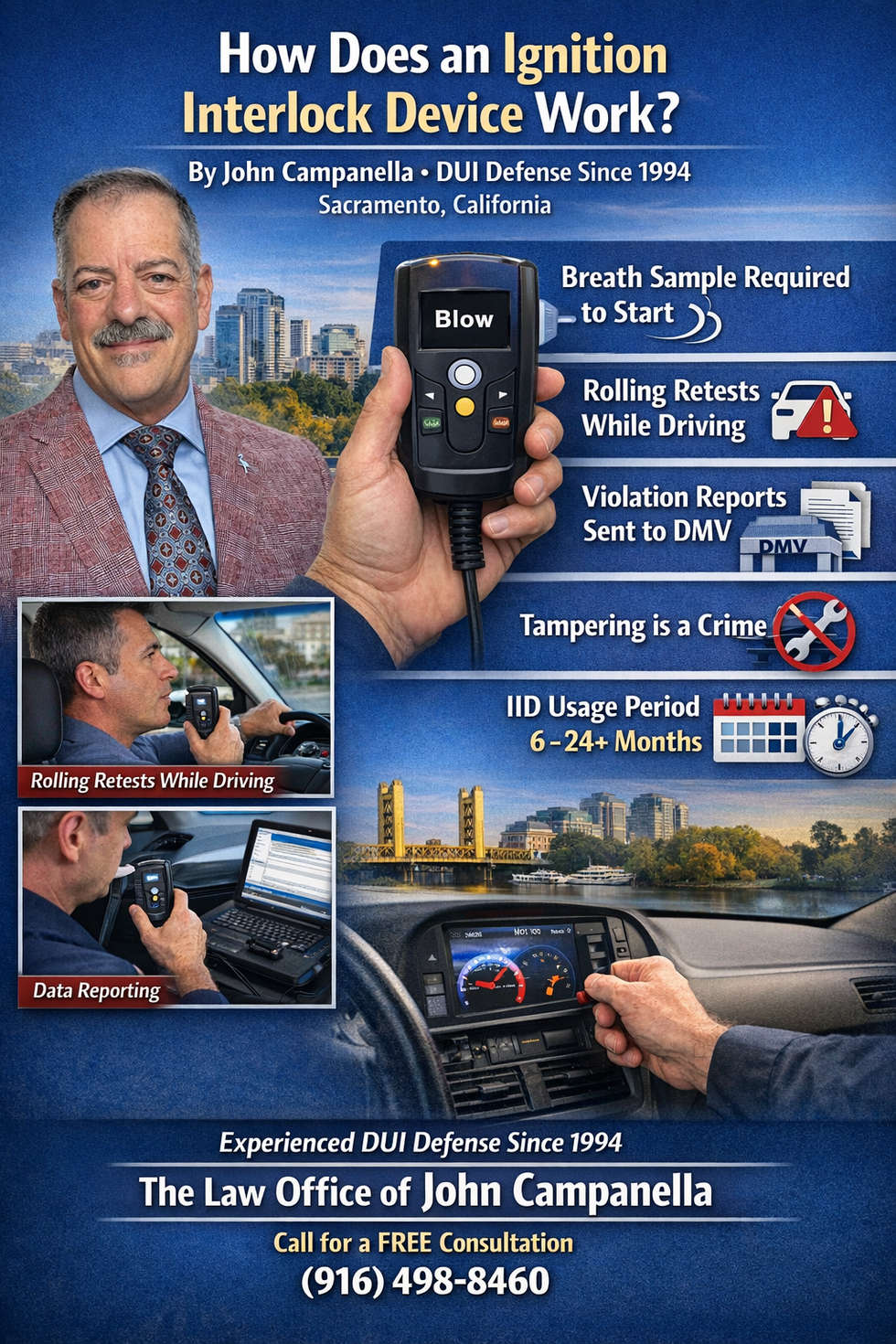
What Is an Ignition Interlock Device?
An ignition interlock device is a small breath-testing machine installed in your vehicle. It connects directly to your vehicle's ignition system. Before your car will start, you must provide a breath sample.
If the device detects alcohol above a preset limit (typically 0.02% in California), the engine will not start.
In California, IID requirements are governed by the California Vehicle Code and enforced by the California Department of Motor Vehicles (DMV).
Step-by-Step: How the Device Works
1. Breath Sample Before Starting the Vehicle
When you turn the key or press the start button, the device prompts you to blow into a handheld mouthpiece.
The IID analyzes your breath alcohol concentration (BrAC).
-
If no alcohol is detected (or below the allowed limit), the vehicle starts.
-
If alcohol is detected above the limit, the vehicle will not start.
The device also records the failed attempt.
2. Rolling Retests While Driving
Many people are surprised to learn that testing doesn't stop after the engine starts.
While you are driving, the IID will randomly prompt you for additional breath samples — called “rolling retests.”
You must provide a sample within a set time frame.
If you fail or ignore a rolling retest:
-
The device records the violation.
-
The vehicle may trigger flashing lights or a horn.
-
The information is reported to the monitoring authority.
The car will not shut off immediately for safety reasons, but violations are documented.
3. Data Recording and Reporting
Every IID installed in California records data, including:
-
Start-up tests
-
Failed tests
-
Missed rolling retests
-
Tampering attempts
-
Power disconnections
This data is downloaded during required service appointments, typically every 30 to 60 days. The information is then transmitted to the monitoring authority, usually the DMV.
If violations occur, your IID requirement can be extended — or your driving privilege can be suspended again.
What Happens If You Try to Cheat the Device?
Modern ignition interlock devices are sophisticated. They include:
-
Anti-circumvention technology
-
Breath pattern detection
-
Temperature and airflow analysis
-
Camera verification in some units
Having someone else blow into the device is considered a violation and can result in:
-
Extension of IID period
-
Probation violation
-
Additional criminal charges
-
License re-suspension
In short, attempting to bypass the device almost always makes the situation worse.
When Is an IID Required in California?
Under California law, ignition interlock devices are mandatory in many DUI cases, including:
-
First DUI with injury
-
Second or subsequent DUI offense
-
Certain probation-based restricted licenses
-
Court-ordered installation as part of sentencing
In Sacramento County, courts frequently impose IID conditions as part of DUI probation.
However, whether you must install one — and for how long — depends on several factors:
-
Prior DUI history
-
Whether there was an accident
-
Blood alcohol concentration
-
Whether anyone was injured
-
Whether you refused chemical testing
The criminal court and the DMV operate separately. You may face IID requirements from one or both.
How Long Do You Have to Use It?
IID periods in California commonly range from:
-
6 months
-
12 months
-
24 months
-
36 months (in repeat cases)
The exact duration depends on your specific case and whether you comply fully with all program requirements.
Even one recorded violation can extend your IID term.
Costs of an Ignition Interlock Device
While exact costs vary by provider, drivers are typically responsible for:
-
Installation fee
-
Monthly monitoring fee
-
Removal fee
-
Calibration/service appointments
In California, certified IID providers must meet standards approved by the state. Only authorized installers may legally perform installation.
What If You Don't Own a Vehicle?
If you do not own a car but want driving privileges, you may still be required to install an IID in any vehicle you operate.
Driving a vehicle that does not have a required IID installed is a violation of your restricted license and can result in:
-
Arrest
-
Probation violation
-
Additional charges
-
Full license suspension
Can an IID Be Challenged?
Yes — in some cases.
IID requirements often stem from:
-
A DMV Administrative Per Se suspension
-
A court sentence
-
A negotiated plea agreement
As a Sacramento DUI defense attorney, I carefully examine whether:
-
The traffic stop was lawful
-
The breath or blood test was valid
-
Proper procedures were followed
-
The DMV hearing was requested within 10 days
If the underlying suspension or conviction is successfully challenged, the IID requirement may be avoided or reduced.
Timing is critical.
Common Misconceptions About Ignition Interlock Devices
“It's just like a portable breathalyzer.”
It is more advanced and permanently wired into your vehicle.
“If I fail once, I go to jail.”
Not automatically — but violations can trigger serious consequences.
“It will damage my car.”
When properly installed by a certified provider, it should not damage your vehicle.
“It only tests before I start the car.”
No. Rolling retests occur while driving.
Why Legal Guidance Matters
The IID is not just a machine — it's part of a larger legal process that includes:
-
Criminal court proceedings
-
DMV administrative hearings
-
Probation terms
-
Insurance consequences
A mistake at any stage can affect how long you must use the device — or whether you must use it at all.
Since 1994, I have defended DUI cases throughout Sacramento and Northern California. Every case is different, and the strategy must be tailored to the facts.
If you have been arrested for DUI and are facing an ignition interlock requirement, do not assume your only option is to comply without question. You may have defenses available.
Speak With a Sacramento DUI Defense Attorney Today
If you have questions about how an ignition interlock device works — or whether it can be challenged in your case — I am available to review the details with you personally.
John Campanella
DUI Defense Since 1994
Sacramento, California
The Law Office of John Campanella is available to assist you 24 hours a day, 7 days a week. Please call today at (916) 498-8460 for a free consultation to go over the details of your case.

Comments
There are no comments for this post. Be the first and Add your Comment below.
Leave a Comment