
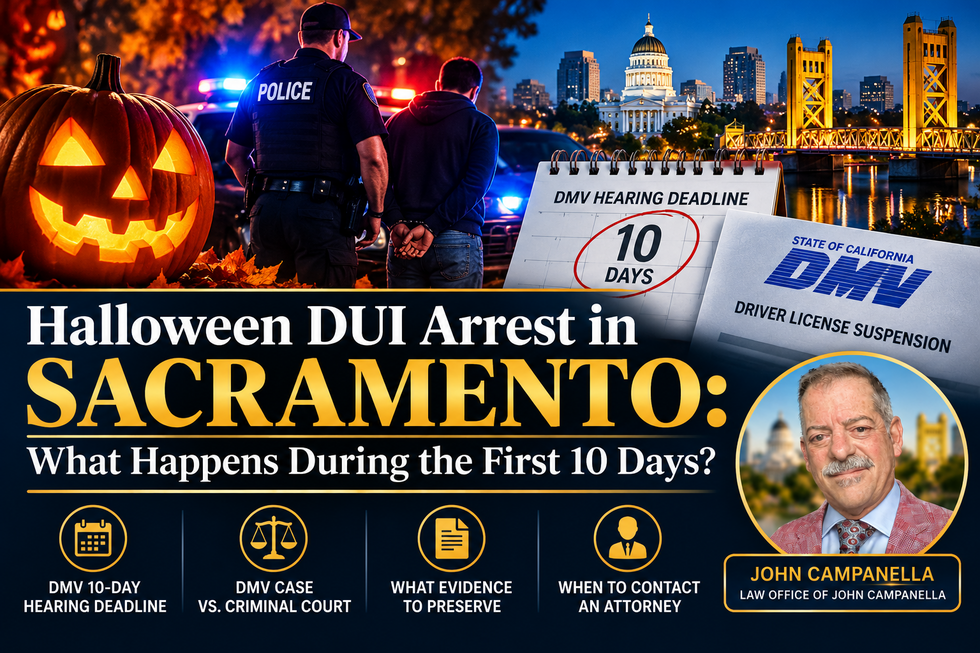
A Halloween DUI arrest in Sacramento can leave you dealing with several questions at once. You may be worried about your driver's license, your upcoming court date, your job, and what a DUI charge could mean for your future. If the arrest happened after a Halloween party, a night out in Midtown, or an evening celebration elsewhere in Sacramento County, the first few days are an important time to understand what happens next.
I am John Campanella of the Law Office of John Campanella. In my DUI defense practice, I look at the criminal case and the driver's license consequences as separate but related matters. One of the most important things I want people to understand after a DUI arrest is that waiting for the first court date may cause them to overlook a separate deadline involving their driving privileges.
If you have recently been arrested for DUI, check the paperwork you received from the officer and identify any DMV hearing deadline immediately. California generally gives a driver 10 days from receipt of the suspension or revocation order to request an administrative hearing. The instructions on your specific notice matter, so do not delay while trying to work out every detail of the case.
Important first step: Keep your DUI paperwork, note the date you received the DMV order, and contact a qualified DUI defense attorney promptly if you need help understanding the deadline. A criminal court date does not replace a DMV hearing request.
What Happens After a Halloween DUI Arrest in Sacramento?
The exact process depends on the circumstances of the stop, the investigation, the test results, and whether there are additional allegations. However, a DUI arrest commonly begins a process involving law enforcement, the California Department of Motor Vehicles (DMV), and the criminal court system.
1. The officer documents the arrest
Following a DUI investigation, the officer may prepare reports describing the driving observed, the reason for the stop, statements made during the investigation, field sobriety testing, and any breath or blood testing. Depending on the circumstances, the officer may issue a notice relating to the driver's license and forward documents to the DMV.
The report is not the same thing as a final determination of guilt. The allegations and evidence must be evaluated through the applicable legal process.
2. You may be booked or released
After an arrest, a person may be booked and later released, or may be held until a court appearance, depending on the circumstances. Release paperwork may provide information about a future court date or other requirements.
Read every document carefully. Do not assume that being released means the case has ended or that no further action is required.
3. The DMV may begin a separate license action
The DMV can take administrative action against a driving privilege based on qualifying circumstances surrounding a DUI arrest. For example, an administrative action may follow a qualifying chemical-test result or a refusal or failure to complete a required chemical test.
This process is separate from the criminal prosecution. You may need to address the DMV matter even while the criminal charge is still being investigated.
4. The criminal case moves through the court system
The prosecutor may file a criminal complaint. If charges are filed, the case generally proceeds through an arraignment and may involve pretrial hearings, evidence review, motions, negotiations, or trial.
The exact timeline varies. An arrest does not itself establish that a person is guilty, and the eventual outcome depends on the evidence, applicable law, and proceedings in the individual case.
The California DMV's 10-Day DUI Hearing Deadline
For many drivers, the most urgent issue after a DUI arrest is the opportunity to challenge an administrative suspension or revocation of their driving privilege.
California DMV guidance generally states that a hearing must be requested within 10 days of receiving the suspension or revocation order. The notice you received should be reviewed immediately because it identifies the action and provides instructions for responding. Different notice-delivery circumstances and particular types of DMV action can affect how a deadline is calculated.
If the officer took your driver's license and issued an Order of Suspension and Temporary License, keep that document safe. It may contain critical information about your current driving status and the administrative action being considered.
What does a DMV hearing do?
A DMV administrative per se hearing, commonly called an APS hearing, gives you an opportunity to challenge the administrative action affecting your driving privilege. Depending on the case, the hearing may examine issues such as:
- Whether the officer had reasonable cause to believe you were driving under the influence.
- Whether you were lawfully arrested or detained in the circumstances relevant to the action.
- Whether a chemical test showed an alcohol concentration at or above the applicable legal threshold.
- Whether you refused or failed to complete a required chemical test, where that issue applies.
The specific issues depend on the type of action and the facts of your case. A hearing is an opportunity to challenge the DMV's action; it is not a guarantee that the suspension will be set aside.
The official California DMV page on Driving Under the Influence and DMV hearings explains the administrative process and the issues considered.
Do not wait for your criminal court date to ask about the DMV deadline. The DMV hearing request and the criminal court case have different purposes. Missing the administrative deadline can affect your ability to challenge the license action.
Does the 10-Day Deadline Start on the Arrest Date?
Do not assume the deadline is simply 10 calendar days after Halloween or the date of arrest. The DMV's DUI guidance describes the hearing-request period in relation to receipt of the suspension or revocation order. Other DMV administrative hearing guidance may specify different timing rules for notices that are mailed.
To avoid relying on a mistaken calculation, review the exact document you received and contact the DMV or a qualified attorney as soon as possible. If the notice was mailed, delivered later, or received under unusual circumstances, explain those facts when asking about the deadline.
If you are already close to the deadline, do not spend several days trying to assemble every record before asking how to preserve your hearing rights. You can organize additional evidence after you understand the applicable procedure.
Also, do not assume that requesting a hearing automatically gives you permission to drive indefinitely. The temporary license, any suspension order, and the DMV's response determine your current status. Confirm that you are legally authorized to drive before getting behind the wheel.
The DMV Case and the Criminal Court Case Are Different
This distinction is central to understanding what happens after a DUI arrest. The DMV addresses your driving privilege through an administrative proceeding. The criminal court addresses the criminal charge filed by the prosecutor.
| Issue | DMV proceeding | Criminal court |
|---|---|---|
|
Main purpose |
Determine whether the administrative action against your driving privilege is justified. |
Determine the criminal charge and, if there is a conviction, the appropriate sentence. |
|
Who decides? |
A DMV Driver Safety hearing officer. |
A judge or jury, depending on the proceedings. |
|
What is examined? |
The issues relevant to the specific administrative action, including qualifying arrest and chemical-test issues. |
The criminal charge, admissible evidence, legal defenses, and applicable criminal-law requirements. |
|
Possible result |
The administrative action may be sustained or set aside, depending on the evidence and applicable law. |
The case may be dismissed, resolved through a plea, or decided at trial, with sentencing if there is a conviction. |
One proceeding does not automatically decide the other. For example, a DMV decision to sustain a suspension does not itself establish criminal guilt. Likewise, a favorable result in criminal court does not automatically mean that every DMV action has been removed.
That is why I want anyone facing a DUI charge to understand both processes early. You may need to prepare for a DMV hearing while also reviewing the evidence and options in the criminal case.
For additional information, read our related article on the difference between Sacramento DUI court and DMV hearings.
What Evidence Should You Preserve After a Halloween DUI Arrest?
It is easy to forget details in the days following an arrest. I recommend creating a file with the paperwork you received and making a factual timeline of what happened while the information is still reasonably fresh in your memory.
Useful materials may include the following, depending on what is available and relevant to your case.
1. Arrest and DMV paperwork
- The Order of Suspension and Temporary License, if issued.
- Any notice of suspension or revocation and its accompanying instructions.
- Any citation, release paperwork, booking documents, or notice of a court date.
- Any written communication from the DMV or law enforcement.
2. Your own timeline of events
Write down what you remember about the evening, including where you were, when you left, where the stop occurred, what the officer said, and what happened during the investigation. Distinguish what you personally remember from what you learned later.
Do not alter documents or try to make your account fit a particular defense. The purpose of a timeline is to preserve potentially relevant details so that an attorney can evaluate them.
3. Witness and location information
If someone was with you before the stop or witnessed relevant events, record their name and contact information. If a restaurant, venue, parking facility, or other location may have video footage, note the location and approximate time.
Video systems may overwrite recordings, so potentially relevant footage may not remain available indefinitely. Tell your attorney about it promptly. Do not contact witnesses in a way that pressures them to change or coordinate their accounts.
4. Testing and medical information
Keep any documents you received about breath or blood testing. If you have relevant medical records, medication information, or other facts you believe may affect the interpretation of the evidence, preserve them and discuss their relevance with your attorney.
Do not assume that a particular medical condition or medication automatically invalidates a test. Its significance depends on the facts, the available evidence, and the applicable scientific and legal standards.
5. Potential digital evidence
Preserve relevant messages, photographs, receipts, location records, ride-share details, or other digital information that may help establish a timeline. Avoid deleting potentially relevant material or posting detailed accounts of the incident on social media.
Do not attempt to obtain evidence unlawfully or access another person's private account. Let your attorney know what exists so that appropriate steps can be considered.
What Should You Avoid Doing After the Arrest?
When people are anxious about a DUI charge, they may feel pressure to explain what happened immediately. It is better to slow down, preserve the paperwork, and obtain legal advice before making decisions that could affect the case.
- Do not ignore DMV notices. The administrative deadline may arrive before your first criminal court date.
- Do not assume your license is valid. Check the documents and confirm your driving status.
- Do not miss your court date. Follow the release paperwork and any official court instructions.
- Do not delete potential evidence. Preserve relevant records, messages, photographs, and other materials.
- Do not discuss the details publicly. Avoid posting an account of the incident or speculating about the evidence on social media.
- Do not assume the test result tells the whole story. The surrounding circumstances and reliability of the evidence may also require examination.
These steps do not determine the outcome of a DUI case. They help preserve your ability to understand the allegations and make informed decisions about the legal process.
When Should You Contact a Sacramento DUI Defense Attorney?
If you have been arrested for DUI, it can be useful to speak with an attorney as early as possible, particularly when you have received a DMV suspension notice or are unsure how to respond to it.
I would want to review the situation promptly if:
- You are uncertain when the DMV hearing-request deadline expires.
- The officer took your license or issued an Order of Suspension and Temporary License.
- You refused or were unable to complete a chemical test.
- You have questions about the breath or blood test, field sobriety testing, or the basis for the stop.
- You have a prior DUI or another licensing issue that could affect the consequences.
- You need to understand how the DMV action and criminal charge may affect your ability to drive, work, or meet family responsibilities.
A useful legal review should start with the actual paperwork and facts. That means identifying the DMV action and deadline, examining the available reports and test information, and understanding the status of the criminal case. It should not begin with a promise about the outcome.
No attorney can responsibly guarantee that a DMV suspension will be avoided or that a criminal charge will be dismissed before reviewing the evidence and the applicable law.
Frequently Asked Questions
I was arrested for DUI on Halloween in Sacramento. What should I do first?
Read all the paperwork you received, identify any DMV suspension or revocation order, and check the hearing-request deadline immediately. Keep your court and release documents and seek legal advice promptly if you are uncertain about the next step.
Is the DMV hearing the same as my criminal court hearing?
No. The DMV hearing concerns your driving privilege and the administrative action. Criminal court addresses the DUI charge and any criminal consequences. The proceedings are separate and may require separate preparation.
Does the 10-day DMV deadline run from my arrest?
The DMV's DUI guidance generally measures the hearing-request period from receipt of the suspension or revocation order. The notice and circumstances of delivery matter, so check your documents and obtain advice promptly rather than relying on a calculation based only on the arrest date.
Can I still challenge the DMV action if I miss the deadline?
Missing the ordinary deadline can jeopardize your hearing rights. Whether any late request or other procedure is available depends on the circumstances and applicable rules. Contact the DMV or a qualified attorney immediately rather than assuming an exception will apply.
If the DMV suspends my license, does that mean I am guilty of DUI?
No. The DMV's administrative action and the criminal court case are separate. The DMV may make a decision about your driving privilege while the criminal case remains pending.
What documents should I bring to a DUI attorney?
Bring the DMV order and notice, any temporary license, citation and release paperwork, court-date information, and any documents relating to chemical testing. A written timeline and the names of potential witnesses may also be helpful.
Talk With John Campanella About a Sacramento DUI Arrest
A Halloween DUI arrest can raise immediate questions about your license and your future court obligations. The first priority is to understand the DMV notice and any deadline that applies. From there, the evidence and circumstances of the arrest can be reviewed to determine what issues may need attention in the administrative and criminal proceedings.
I am John Campanella of the Law Office of John Campanella. If you were recently arrested for DUI in Sacramento and need help understanding the DMV process or evaluating your criminal case, contact me to discuss your situation.
You can also visit Law Office of John Campanella for additional information about California DUI defense, DMV hearings, and driver's license consequences.

Comments
There are no comments for this post. Be the first and Add your Comment below.
Leave a Comment