
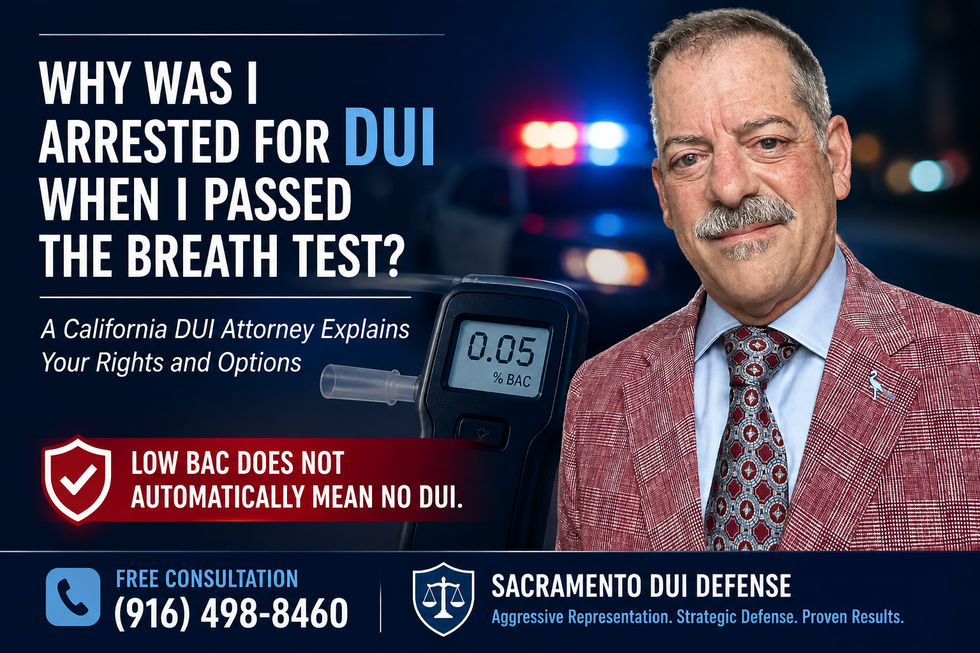
Many people are shocked after being arrested for DUI because they believed they had "passed" the breath test. If your breath test result was below 0.08%, or even 0.00%, you may wonder why the officer arrested you in the first place.
The short answer is California law does not require a breath test result of 0.08% or higher before an officer can make a DUI arrest. A breath test is only one piece of the investigation. Officers also consider your driving, physical appearance, statements, field sobriety tests, and other evidence when deciding whether there is probable cause to believe you were driving under the influence.
That does not mean you are guilty of DUI. An arrest is only the beginning of the legal process, and the prosecutor must still prove the charges beyond a reasonable doubt.
Can You Be Arrested for DUI If Your Breath Test Is Below 0.08%?
Yes.
Many drivers think the legal limit automatically protects them from being arrested. That is a common misunderstanding.
California has different DUI laws that apply in different situations. One law prohibits driving with a blood alcohol concentration (BAC) of 0.08% or higher. Another law makes it illegal to drive while under the influence of alcohol, even if your BAC is below 0.08%, if your mental or physical abilities are impaired to the extent that you can no longer drive with the caution of a sober person under similar circumstances.
Because of this, a breath test below 0.08% does not automatically end a DUI investigation.
What Does a Breath Test Actually Measure?
A breath test measures the amount of alcohol in your breath and estimates your blood alcohol concentration.
It does not measure:
- Marijuana
- Cocaine
- Methamphetamine
- Prescription medications
- Most other drugs
It also cannot determine whether you are actually driving safely. It simply measures alcohol.
That is why officers continue looking at the entire situation instead of relying only on the breath test result.
Why Would an Officer Arrest Someone After a Low Breath Test?
There are several reasons why this may happen.
The Officer Believes Alcohol Still Affected Your Driving
Even if your BAC is below 0.08%, an officer may believe alcohol impaired your ability to drive safely.
For example, the officer may claim that you:
- Drifted between lanes
- Failed to stop at a stop sign
- Drove significantly below or above the speed limit
- Had delayed reactions
- Showed poor coordination
These observations may become part of the evidence in the case.
Keep in mind that an officer's observations can be challenged. Nervousness, fatigue, illness, or medical conditions may explain some of the same behaviors.
The Officer Suspects Drug Impairment
A low breath alcohol result does not rule out drug impairment.
California law also prohibits driving while impaired by drugs, including:
- Marijuana
- Prescription pain medication
- Anti-anxiety medication
- Sleep medication
- Illegal drugs
- Certain over-the-counter medications that cause drowsiness
If the officer believes drugs affected your driving, the investigation may continue even when the breath test shows little or no alcohol.
The Officer Believes Alcohol and Drugs Were Combined
Sometimes officers suspect that alcohol and drugs were used together.
Even a small amount of alcohol combined with certain medications or drugs may affect driving ability.
In those situations, a breath test alone does not answer the entire question.
Does a Breath Test Measure Marijuana?
No.
Breath testing devices used in California DUI investigations are designed to measure alcohol, not marijuana or most other drugs.
If an officer suspects drug impairment, they may request a blood test after a lawful DUI arrest.
However, the presence of a drug in a blood sample does not automatically prove that the person was impaired while driving. The prosecution must still prove the elements of the charged offense.
What Is Probable Cause?
Many people believe the police need proof that they are guilty before making an arrest.
That is not how the law works.
To arrest someone for DUI, an officer generally needs probable cause. This means the officer must have enough facts to reasonably believe that the person committed a DUI offense.
Those facts may include:
- Driving behavior
- Physical appearance
- Statements made by the driver
- Field sobriety test performance
- The odor of an alcoholic beverage
- The results of a breath test
- Other observations made during the investigation
Whether probable cause actually existed can later become an important issue in court.
Is a Breath Test the Only Evidence in a DUI Case?
No.
A DUI case often includes many different types of evidence.
The prosecutor may rely on:
- Police reports
- Body camera video
- Dash camera video
- Witness statements
- Field sobriety tests
- Chemical test results
- Officer observations
The court considers all of the evidence together, not just the breath test result.
What If My Breath Test Was 0.00%?
A 0.00% breath test does not automatically prevent a DUI arrest.
If the officer believes you were impaired by drugs or another substance, you may still be arrested and asked to submit to a chemical test as required under California's implied consent law following a lawful DUI arrest.
Again, an arrest is not a conviction. The prosecution must still prove its case in court.
Can You Challenge a DUI Arrest After a Low Breath Test?
Yes.
Every DUI case should be carefully reviewed.
Depending on the facts, possible issues may include:
Whether the Traffic Stop Was Lawful
Police generally need a lawful reason to stop a vehicle.
If the stop violated your constitutional rights, some evidence may be challenged.
Whether the Officer Had Probable Cause to Arrest
An officer's conclusion that someone was impaired is not automatically correct.
A defense attorney can review:
- Body camera footage
- Dash camera video
- Police reports
- Witness statements
to determine whether probable cause actually existed.
Whether Field Sobriety Tests Were Reliable
Field sobriety tests are affected by many factors unrelated to alcohol or drugs.
For example:
- Uneven pavement
- Poor lighting
- Back injuries
- Knee problems
- Balance disorders
- Fatigue
- Age
- Weather conditions
- Nervousness
A poor performance does not necessarily mean a driver was impaired.
Whether Medical Conditions Explained the Officer's Observations
Certain medical conditions may resemble signs of intoxication.
Examples include:
- Inner ear disorders
- Diabetes
- Neurological conditions
- Fatigue
- Allergies
- Anxiety
A careful review of the facts may reveal alternative explanations for the officer's observations.
What Happens After a DUI Arrest?
After a DUI arrest, two separate processes may begin.
Criminal Court Case
The criminal court determines whether the prosecution can prove the DUI charge.
Possible outcomes include:
- Dismissal
- Reduced charges
- Plea agreement
- Trial
DMV Administrative Proceeding
The California Department of Motor Vehicles may also take action regarding your driving privilege.
The DMV process is separate from the criminal court case, and each has its own procedures and deadlines.
Frequently Asked Questions
Can I get a DUI if I blew 0.05%?
Yes. A breath test result below 0.08% does not automatically prevent DUI charges. Prosecutors may still attempt to prove that alcohol impaired your ability to drive safely, depending on the evidence.
If I blew 0.00%, shouldn't I have been released?
Not necessarily. If an officer reasonably suspects impairment by drugs or another substance, the investigation may continue.
Does a low breath test mean my case will be dismissed?
No. Likewise, it does not mean you will be convicted. The outcome depends on the evidence, the applicable law, and the specific facts of your case.
Can a DUI attorney help if my breath test was below 0.08%?
Yes. A defense attorney can review the legality of the traffic stop, the officer's observations, chemical testing procedures, body camera footage, and other evidence to determine whether the charges can be challenged.
Speak With a Sacramento DUI Attorney About Your Case
Being arrested after blowing below 0.08% can be confusing, but it does not automatically mean the arrest was unlawful or that a conviction is inevitable. California DUI cases often involve questions about probable cause, impairment, chemical testing, and the reliability of the evidence.
If you were arrested for DUI, an experienced Sacramento DUI defense attorney can review the facts of your case, explain your legal options, and help protect your rights throughout the court process.
Disclaimer: This article is provided for general informational purposes only and should not be considered legal advice. Every DUI case is unique. Reading this article does not create an attorney-client relationship. If you have been arrested for DUI in California, consult a qualified DUI defense attorney to discuss the specific facts of your case.

Comments
There are no comments for this post. Be the first and Add your Comment below.
Leave a Comment