
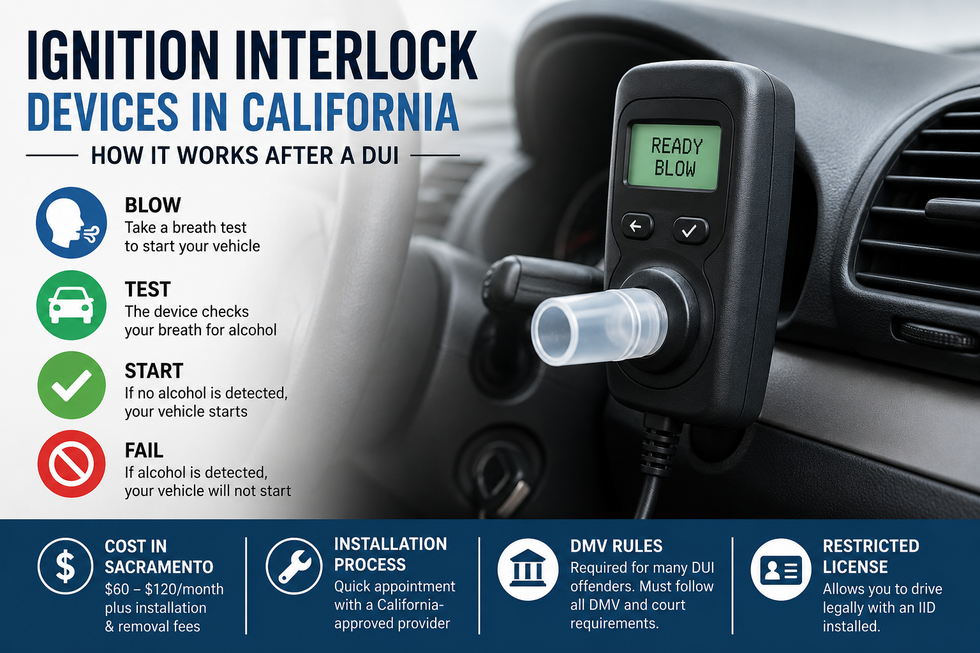
Getting arrested for driving under the influence in California can lead to several penalties, including fines, DUI school, license suspension, and the requirement to install an Ignition Interlock Device (IID). In recent years, California expanded its ignition interlock laws, making IIDs mandatory for many DUI offenders across the state, including Sacramento.
Many drivers are confused about how the system works, how much it costs, how long they must keep it installed, and what happens if they violate IID rules. Understanding California ignition interlock requirements can help drivers avoid additional penalties and restore their driving privileges legally.
What Is an Ignition Interlock Device?
An Ignition Interlock Device is a small breath-testing machine connected to a vehicle's ignition system. Before the vehicle can start, the driver must blow into the device. If alcohol is detected above the preset limit, the car will not start.
The IID is commonly referred to as a DUI breathalyzer device in California because it works similarly to a portable breath alcohol tester used by law enforcement officers.
California requires many DUI offenders to install an IID after a DUI conviction or after a DMV administrative suspension.
How an IID Works in California
The device is installed directly into the vehicle's ignition system by a state-approved provider. After installation, the driver must provide a breath sample every time they start the vehicle.
Starting the Vehicle
The process usually works like this:
- The driver blows into the mouthpiece.
- The IID analyzes the breath sample for alcohol.
- If the alcohol level is below the allowed threshold, the vehicle starts.
- If alcohol is detected above the limit, the vehicle remains locked.
Most California ignition interlock devices also require rolling retests while driving.
Rolling Retests
A rolling retest occurs while the vehicle is already in motion. The device will alert the driver to provide another breath sample within a certain amount of time.
If the driver fails the retest or ignores it, the device may:
- Trigger alarms
- Flash lights
- Record the violation
- Report the incident to monitoring authorities
The vehicle usually will not shut off while driving for safety reasons, but violations are logged and may create serious consequences.
California Ignition Interlock Laws
California expanded its IID program statewide several years ago, and newer legislation continues to strengthen enforcement requirements.
Drivers convicted of DUI offenses may be ordered to install an IID for:
- First-time DUI offenses
- Repeat DUI convictions
- DUI causing injury
- Refusing chemical testing in some cases
The California DMV and criminal court can both impose IID requirements.
AB 366 and Expanded IID Requirements
California lawmakers have continued expanding ignition interlock requirements under newer DUI legislation. These changes increased monitoring rules and strengthened penalties for noncompliance.
Because of these changes, ignition interlock content has become one of the most searched DUI-related topics in California.
Who Must Install an IID in California?
Not every DUI arrest automatically leads to an IID requirement, but many convictions now do.
First DUI Offense
A first DUI offender may:
- Install an IID immediately and continue driving legally
- Or wait through a license suspension period
Many drivers choose the IID option because it allows them to continue commuting to work, school, and other necessary activities.
Second or Third DUI Offense
Repeat offenders almost always face mandatory IID installation requirements. The duration increases with each conviction.
DUI Causing Injury
Drivers convicted of causing injury while driving under the influence typically face longer IID requirements and stricter DMV conditions.
How Long Must You Keep an IID in California?
The required IID period depends on the DUI offense and the driver's history.
Typical California IID Durations
First DUI
Usually up to 6 months.
Second DUI
Often 1 year.
Third DUI
Typically 2 years.
Fourth or Multiple DUI Convictions
Can require 3 years or more.
The court or DMV may extend the IID period if violations occur.
IID Installation Process in Sacramento
Drivers in Sacramento must use a California-approved IID provider.
Step 1: Choose an Approved IID Provider
California approves several ignition interlock companies, including:
- Intoxalock
- Smart Start
- LifeSafer
- Draeger
Many Sacramento drivers search specifically for:
- IID Sacramento
- Intoxalock California rules
- DUI breathalyzer device California
Step 2: Schedule Installation
Installation usually takes a few hours. The technician connects the IID to the vehicle ignition system and explains how to use the device.
Step 3: Submit Proof to DMV
After installation, the provider sends proof electronically or gives the driver paperwork to submit to the California DMV.
Without proof of installation, restricted driving privileges will not be activated.
Step 4: Maintain Monthly Monitoring
Drivers must return regularly for:
- Calibration
- Data downloads
- Maintenance checks
Missing appointments can create violations.
Cost of an IID in Sacramento
The total cost of an ignition interlock device in Sacramento varies depending on:
- Provider
- Vehicle type
- Duration requirement
- Monitoring fees
Typical IID Costs in Sacramento
Installation Fee
Usually between $70 and $150.
Monthly Monitoring Fee
Generally between $60 and $120 per month.
Removal Fee
Usually between $50 and $100.
Estimated Total Costs
A first-time DUI offender may spend:
- $500 to $1,500 overall
Repeat offenders with longer IID requirements can pay several thousand dollars over time.
California DMV Rules for Ignition Interlock Devices
The California DMV has strict rules regarding IID compliance.
Requirements for Restricted License
Drivers seeking an IID restricted license usually must:
- Install an IID
- Provide SR-22 insurance
- Pay DMV reissue fees
- Enroll in DUI school
- Meet suspension requirements
Once approved, drivers may legally operate vehicles equipped with an IID.
What Is an IID Restricted License?
An IID restricted license allows DUI offenders to continue driving during suspension periods if all conditions are met.
Unlike older restricted licenses that only allowed driving to work or DUI school, IID restrictions often allow broader driving privileges.
Benefits of an IID Restricted License
Drivers may legally:
- Drive to work
- Drive to school
- Attend medical appointments
- Transport family members
- Run daily errands
This is one reason many California drivers choose the IID option after a DUI.
Common IID Violations in California
IID violations can create serious problems and may extend the IID period or suspend driving privileges again.
Failed Breath Tests
If alcohol is detected:
- The event is recorded
- Multiple failed tests may trigger penalties
Skipping Rolling Retests
Ignoring rolling retest requests may count as a violation.
Tampering With the Device
Attempting to bypass or disable the IID can lead to:
- Criminal charges
- Extended IID periods
- Additional license suspensions
Missing Service Appointments
California requires regular maintenance appointments. Missing them may place the device into violation mode.
Driving a Vehicle Without an IID
If restricted drivers operate a vehicle without the required IID installed, they can face:
- License violations
- Additional criminal penalties
- Probation violations
Can Someone Else Blow Into the IID?
California law prohibits another person from providing breath samples for the driver.
Trying to bypass the system using another person can result in:
- Probation violations
- Court sanctions
- IID extensions
- Additional criminal consequences
What Happens if You Fail an IID Test?
Failing a test does not automatically create a new DUI charge, but repeated failures can create serious administrative issues.
The IID records:
- Alcohol levels
- Test failures
- Missed retests
- Tampering attempts
These records may be reviewed by:
- DMV officials
- Courts
- Probation departments
Removing an IID in California
Drivers cannot simply disconnect the device on their own.
Proper Removal Process
At the end of the IID period:
- The driver confirms eligibility with DMV or court.
- The provider removes the device professionally.
- Final compliance records are submitted.
Removing the IID early without authorization can create violations.
Can You Drive Any Car With an IID Restriction?
Usually, every vehicle operated by the restricted driver must have an IID installed.
There are limited exceptions involving:
- Employer-owned vehicles
- Certain work vehicles
- Commercial driving situations
However, special documentation may be required.
IID Rules for Commercial Drivers
Commercial drivers often face stricter consequences after DUI convictions.
A CDL holder may:
- Lose commercial driving privileges
- Face employment issues
- Be restricted from operating commercial vehicles even with an IID
How to Stay Compliant With California IID Rules
Drivers can avoid violations by:
- Never drinking before driving
- Attending all maintenance appointments
- Following calibration schedules
- Avoiding tampering
- Responding to rolling retests immediately
Maintaining full compliance helps drivers complete the IID requirement successfully and regain unrestricted driving privileges faster.
Final Thoughts on California Ignition Interlock Devices
Ignition interlock devices are now a major part of California DUI enforcement. Sacramento drivers convicted of DUI offenses often must install an IID to continue driving legally during suspension periods.
Understanding California IID laws, DMV requirements, installation costs, and compliance rules is extremely important because violations can lead to longer restrictions and additional penalties.
As California continues expanding DUI enforcement policies, ignition interlock devices will likely remain one of the most common requirements after a DUI conviction.

Comments
There are no comments for this post. Be the first and Add your Comment below.
Leave a Comment