
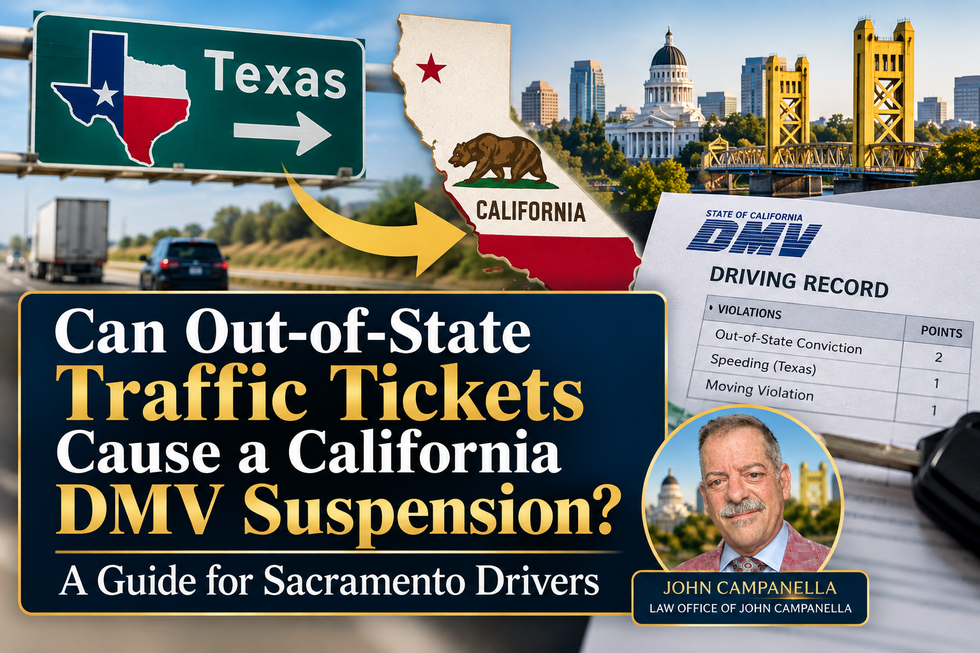
A traffic ticket from Texas or another state can follow you back to California. If you live in Sacramento and hold a California driver's license, an out-of-state conviction may affect your California driving record and, in some circumstances, contribute to a driver's license suspension.
I am John Campanella, and I handle California DUI defense and related driving-privilege matters. One important point I want drivers to understand is that receiving a ticket in another state does not automatically mean your California license will be suspended. The outcome depends on the violation, the conviction reported to the California DMV, your existing driving record, and the rules that apply to your situation.
If you recently received a Texas traffic conviction or learned that an out-of-state violation has appeared on your California driving record, it is worth checking exactly what the DMV has recorded before assuming the worst.
Can an Out-of-State Traffic Ticket Affect a California Driver's License?
Yes. California DMV rules allow certain out-of-state traffic convictions to count toward a driver's negligent-operator point total.
California Vehicle Code section 13363 addresses how the DMV evaluates out-of-state convictions. The department determines whether the same violation, if committed in California, would carry negligent-operator points or provide grounds for suspension or revocation.
That distinction matters. The California DMV does not simply assign points because a ticket came from another state. It evaluates the reported offense under California's applicable rules.
For example, a driver who receives a moving violation in another state may find that the conviction is reported to California and considered when the DMV reviews the driver's record. Whether it receives points, and how many, depends on the violation and the applicable California classification.
You can review the DMV's explanation of negligent-operator points and out-of-state convictions for the department's official guidance.
What If the Traffic Ticket Came From Texas?
Texas tickets deserve the same careful review as traffic convictions from other states. If you hold a California driver's license and receive a traffic conviction in Texas, the California DMV may consider the reported conviction under California's out-of-state violation rules.
The key question is not simply whether Texas considers the offense a moving violation. The question is how California evaluates the reported conduct for driving-record and licensing purposes.
Here are some factors that may matter:
- The exact offense: The statutory violation or offense description reported by the Texas court can affect how California evaluates it.
- The disposition: A citation, a pending case, a dismissed charge, and a final conviction are not interchangeable.
- The information reported: The DMV needs accurate information about the offense and its disposition to maintain the proper record.
- Your existing record: Even a relatively minor conviction may matter more if you already have several points within the relevant period.
- Any separate licensing issue: A failure to appear, an unresolved court matter, or another licensing action may raise questions beyond the point value of the original ticket.
Do not assume that every Texas speeding ticket will produce a California point, or that a ticket issued in Texas can never affect your California license. The actual offense and the way it is reported need to be examined.
If the Texas case involved an allegation such as reckless driving, driving under the influence, or another serious offense, I would want to review the underlying records rather than rely on the short description printed on a notice.
How California DMV Negligent-Operator Points Work
The California DMV uses the Negligent Operator Treatment System, commonly called NOTS, to identify drivers whose records show a pattern of traffic violations or responsible collisions. Out-of-state convictions may contribute to that review when California assigns points under the applicable rules.
For an ordinary adult driver, the commonly published NOTS point thresholds are:
| Period | Point total | Potential DMV action |
|---|---|---|
|
12 months |
2 points |
Warning letter threshold |
|
24 months |
4 points |
Warning letter threshold |
|
36 months |
6 points |
Warning letter threshold |
|
12 months |
4 points |
Potential Level III probation and suspension action |
|
24 months |
6 points |
Potential Level III probation and suspension action |
|
36 months |
8 points |
Potential Level III probation and suspension action |
These are general NOTS thresholds for ordinary adult drivers, not a prediction that a suspension will automatically occur in every case. The DMV's specific action depends on the driver's circumstances and applicable rules. Commercial drivers and provisional drivers may be subject to different requirements.
California generally assigns one point to many routine moving violations and two points to certain more serious offenses. The DMV evaluates out-of-state convictions to determine whether the equivalent California violation carries points or other licensing consequences.
A point total can lead to a warning, a notice of intent to suspend, or a more serious action. A driver facing a proposed suspension should review the notice carefully because it may explain the action, the effective date, and the available hearing rights.
For the official explanation, see the California DMV's Negligent Operator Treatment System actions.
How to Check Your California Driving Record
If you are concerned that a Texas or other out-of-state ticket has affected your license, start by obtaining a copy of your California driving record. Do not rely only on an insurance notice, an online ticket summary, or what someone tells you over the phone.
When reviewing your record, look for:
- The out-of-state conviction and its reported date.
- The offense description and any point value assigned.
- Whether the entry appears more than once.
- Whether a dismissal, amended charge, or other final court disposition is missing.
- Whether the dates and details match your court documents.
- Any warning letter, probation order, suspension notice, or other DMV action.
You can begin through the California DMV's online driver record request service.
Keep copies of the ticket, court disposition, payment receipt, dismissal order if applicable, and any correspondence from the other state's court or licensing agency. These documents may help establish whether the information on your California record is correct.
What If the California DMV Record Contains an Error?
Errors can matter, particularly when a driver is close to a negligent-operator threshold. The problem might be an incorrect offense description, a conviction that was later dismissed or changed, duplicate information, or a court disposition that has not been properly reflected.
If you believe a traffic conviction has been recorded incorrectly, the California DMV provides a Driver License Record Correction Request (DL 207) for traffic violation and conviction information.
The DMV explains that supporting documentation from the court is necessary to correct a traffic conviction entry. Depending on the issue, that may include an appropriate court document or a signed or certified court letter.
In practice, I would begin by identifying the exact entry that appears wrong and comparing it with the official court record. If the Texas court entered a different disposition from the one appearing on the California record, obtain documentation showing what the court actually decided. A correction request should be supported by evidence, not just a statement that the record looks incorrect.
Correcting an entry and challenging a suspension are not necessarily the same process. If the DMV has already issued a suspension or probation order, do not assume that submitting a record-correction request automatically stops the action.
Can You Challenge a DMV Suspension Based on Out-of-State Tickets?
Depending on the circumstances, a driver may have grounds to challenge the accuracy of the record or the DMV's decision to take action. The appropriate approach depends on the notice received and the specific issue involved.
For example, a review may be appropriate if:
- The DMV appears to have assigned points to an offense that may not qualify under the applicable California rules.
- The reported conviction does not match the final court disposition.
- A duplicate or otherwise inaccurate entry affects the point total.
- The DMV's point calculation appears inconsistent with the dates or offenses shown in the record.
- The driver has received a NOTS notice and wants to present evidence about the accuracy of the record or the proposed action.
California DMV NOTS hearings can address the correctness of a driving record, the driver's history, and whether action against the driving privilege is appropriate. The DMV's official NOTS hearing guidance explains the purpose and scope of these proceedings.
Deadlines are important. If you receive a notice proposing action against your license, read it immediately and follow the hearing instructions stated in the notice. Do not wait for a record-correction request to be completed before investigating any separate deadline to challenge the proposed action.
When Should Sacramento Drivers Speak With a Lawyer?
Not every out-of-state traffic ticket requires a lawyer. A straightforward citation with no dispute and no meaningful licensing consequences may be handled through the relevant court process. The situation deserves closer attention when a conviction could affect your California driving privileges.
I would consider a legal review particularly important when:
- You have received a California DMV suspension or probation notice.
- You believe an out-of-state conviction was incorrectly classified or reported.
- You have several recent violations and are concerned about reaching a NOTS threshold.
- The ticket involved an offense that could carry more serious consequences in California.
- You hold a commercial driver's license or depend on driving for work.
- You are unsure which deadline applies or how to request a DMV hearing.
A review should begin with the documents: the California driving record, the out-of-state court disposition, the DMV notice, and the relevant dates. Those records help determine whether the concern is a reporting error, a point calculation issue, a court matter, or a separate DMV action.
I would not promise that a ticket can be removed or that a suspension can be prevented without reviewing the facts. The goal is to identify the actual legal and procedural issues, understand the available options, and act before an important deadline passes.
Frequently Asked Questions
Will a Texas speeding ticket automatically add points to my California license?
No. The California DMV evaluates the reported out-of-state conviction under California's applicable rules. Whether points are assigned depends on the specific offense and its treatment under California law.
Can one out-of-state ticket suspend my California driver's license?
A routine ticket does not automatically cause a suspension. However, certain serious offenses or separate licensing issues may have consequences beyond an ordinary point assessment. Your existing driving record and the exact violation matter.
How do I find out whether an out-of-state conviction is on my record?
Request your California driving record through the DMV and compare any out-of-state entry with your court documents. Review the offense description, dates, point value, and any related DMV notice.
What if the Texas court dismissed my ticket, but California still shows a conviction?
Obtain official documentation showing the final disposition and determine what was reported to California. You may need to contact the court or submit the DMV's record-correction request with supporting documentation.
Does requesting a correction automatically stop a California DMV suspension?
No. Do not assume a correction request pauses a separate suspension or hearing deadline. Follow the instructions on your DMV notice and address any pending action promptly.
Should I speak with a Sacramento attorney about an out-of-state ticket?
Legal review may be useful if the conviction could affect your license, your driving record appears inaccurate, you have received a suspension notice, or you need help understanding the available challenge procedures.
Get Help Reviewing an Out-of-State Traffic Conviction
If you live in the Sacramento area and are concerned that a Texas or other out-of-state traffic conviction could affect your California driver's license, start by obtaining your driving record and gathering the relevant court documents. Those records can help clarify what the DMV has reported and whether further action is warranted.
I am John Campanella of the Law Office of John Campanella. If you need help understanding a California DMV notice, reviewing a possible record error, or evaluating a potential negligent-operator suspension, contact me to discuss your situation.
You can also visit Sacramento DUI Information for additional information about California DUI and driving-privilege issues.

Comments
There are no comments for this post. Be the first and Add your Comment below.
Leave a Comment